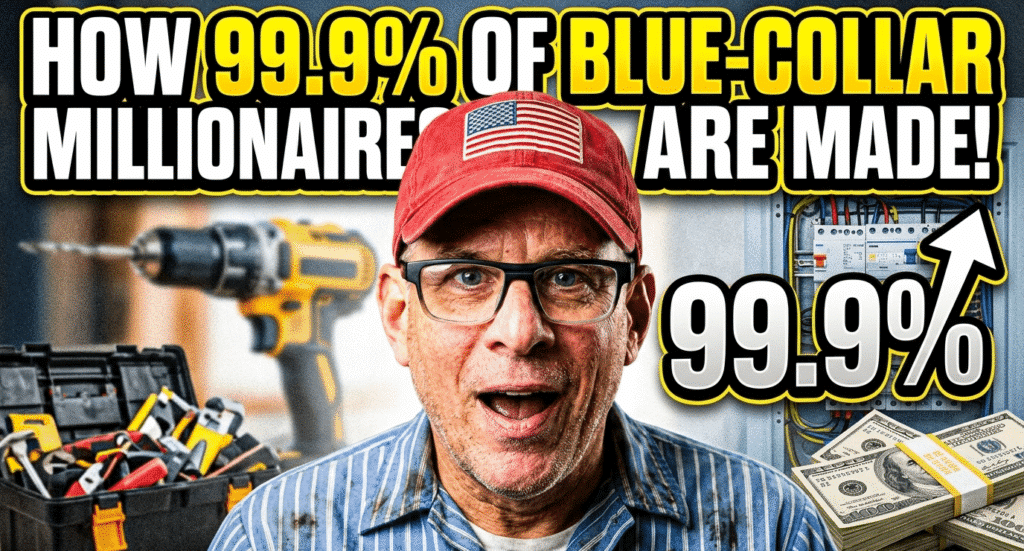
How 99.9% Of Blue Collar Millionaires Are Made!
I still remember the first time someone asked me how 99.9% of blue collar millionaires are made. It wasn’t some fancy seminar. It was after a long shift, sitting in a truck outside a job site, talking with a guy who’d just paid off his house at 42. No inheritance. No lottery ticket. Just tools, overtime, and a plan most people never bother to write down.
That conversation stuck. After more than 30 years in the trades myself as a senior auto inspector and someone who’s watched hundreds of guys come up through the ranks I’ve seen the same pattern over and over. The ones who build real wealth in trades careers don’t do it by chasing the next viral side hustle or waiting for a big raise. They follow a quiet, repeatable path that turns steady paychecks into something that compounds for decades.
This is the exact playbook I break down on JV CHARLES TV, and it’s backed by the same research that filled The Millionaire Next Door. Most millionaires in this country are first-generation. Two-thirds are self-employed. And a huge share of those self-employed folks run what look like ordinary blue collar businesses plumbing outfits, hvac shops, electrical contractors, welding operations. Not tech startups. Not hedge funds. Just skilled work done well, priced right, and run like a real business.
Key Takeaways
- Most blue collar millionaires never hit a single “home run.” They stack small advantages over 15–20 years.
- Starting in skilled trades lets you earn while you learn and leave with six figures zero debt.
- Specializing (and then owning the business) is what separates the solid journeyman from the guy who retires early.
- Living below your means and investing the difference turns overtime into real wealth.
- Recurring service work and Blue Collar Side Hustles create cash flow that keeps working when you’re not on the tools.
Why Trades Careers Quietly Create More Millionaires Than Most People Realize
College debt averages tens of thousands. A solid apprenticeship or trade school program often costs a fraction of that or pays you while you train. You walk into the workforce with skills that can’t be outsourced and demand that keeps rising. Construction alone has needed hundreds of thousands of new workers year after year. The shortage isn’t going away.
Look at the latest Bureau of Labor Statistics numbers (May 2025 data). Elevator installers and repairers sit near the top of the highest paying skilled trades with a national median around $109,910. Power-line workers come in strong too. Even the more common building trades land in solid territory: plumbers, pipefitters, and steamfitters at about $63,800 median, electricians right around $63,190, and hvac technicians at $61,010. The top 10 percent in several of these fields clear well over $100,000 as employees. Owners routinely go higher.
Plumbers pay jumps even more once you add overtime, specialty certs, or a commercial focus. The same holds for hvac. A residential service tech can do fine. A commercial refrigeration or controls specialist commands a real premium. That’s the difference between a good living and the kind of income that funds serious investing.
The real leap happens when you stop selling only your own hours.
The Five-Step Path Almost Every Blue Collar Millionaire Follows
Step 1: Live Below Your Means on Purpose
Budget like the overtime doesn’t exist. Pay your bills and set aside savings and investments from your base 40-hour check. Treat every extra hour as fuel for the future, not lifestyle upgrades. The guys who buy the newer truck every three years and the bigger house the minute they can afford the payment stay stuck. The ones who keep driving the paid-off van and live in a place that costs less than they can handle end up with options.
Step 2: Specialize Until You Command Premium Rates
A general journeyman electrician might sit in the $30–$45 range depending on the market. Add PLC programming, EV charger installation (NEC 625 knowledge), building automation, or high-end commercial work and the rate climbs. Same tools, different paycheck. In hvac, EPA 608 is the baseline. Layer on commercial refrigeration or controls and the phone starts ringing for higher-dollar calls. Plumbing has the same pattern medical gas, backflow, or large commercial work separates the average from the highly paid.
Step 3: Own the Boring Business
You can start a one-truck hvac, plumbing, or electrical operation with surprisingly little cash often in the $5,000 to $11,000 range for a reliable van, tools, insurance, and licensing. The average trades business owner lands somewhere between $86,000 and $150,000. Owners who run tight shops with recurring service agreements push past $150,000–$200,000 and keep climbing. The businesses that scale best sell maintenance contracts, not just emergency calls. Those monthly or quarterly checks keep coming even when the weather is mild.
Step 4: Invest the Gap
The difference between what you earn and what you spend goes into 401(k)s, Roth IRAs, pensions if you’re union, and eventually real estate. A paid-off rental or two becomes another stream that doesn’t care if your back is sore that week. Many of the millionaires I’ve watched simply never stopped putting money away once the business started throwing off cash.
Step 5: Let Time and Compound Interest Do the Heavy Lifting
Sixteen thousand dollars a year invested at a reasonable long-term rate can grow into seven figures over a couple of decades. The math isn’t flashy. It’s just consistent. That’s why so many of these guys look ordinary on paper until you see the net worth statement.
Blue Collar Side Hustles That Actually Move the Needle
While you’re still working for someone else, smart Blue Collar Side Hustles accelerate the process. Weekend drain cleaning, after-hours hvac tune-ups during peak season, EV charger installs, garage door repair, or small engine work can clear serious extra cash without needing a second full business. Stack a couple of these and the money that used to disappear into lifestyle upgrades starts funding the next step better tools, a second truck, or the first investment property.
The key is treating the side work with the same professionalism as the day job. Show up on time, do clean work, and ask for the next referral. Word of mouth in the trades still beats most advertising.

What the Data and the Job Sites Both Show
Demand for high paying skilled trades remains strong. Job growth projections for electricians, hvac techs, and several specialty roles sit above average. Automation and AI are changing office work faster than they are changing the need for someone who can diagnose a complex system on a rooftop or in a mechanical room. The skills you build with your hands stay relevant.
I’ve watched guys start as helpers making modest hourly wages and, fifteen years later, run multi-crew operations doing seven figures in revenue. I’ve also watched talented journeymen stay stuck because they never specialized, never controlled their spending, and never took the ownership step. The difference almost always comes down to the five steps above.
FAQs
Do I need a four-year degree to reach six figures in the trades?
No. Apprenticeships, trade school, and on-the-job training are the normal routes. Many of the highest paying skilled trades require licenses and certifications, not bachelor’s degrees.
How long does it typically take to hit six figures as an employee?
With specialization, overtime, and the right market, many reach it in 5–10 years. Ownership shortens the path for those willing to run the business side.
What’s the fastest way to increase my current trades income?
Get the specialty certifications that match local demand, then price your work (or your side work) accordingly. Recurring maintenance contracts are pure gold.
Is starting my own company really realistic with limited capital?
Yes for service-based trades. A reliable vehicle, tools you already own or can buy used, proper licensing and insurance, and a phone are the core requirements. Many start evenings and weekends while keeping the day job.
Where can I find current salary data and training options?
Bureau of Labor Statistics Occupational Employment and Wage Statistics is the cleanest public source. Local unions, community colleges, and industry associations (UA, IBEW, ACCA, etc.) are the practical next steps.
Final Thought from the Shop Floor
The path isn’t glamorous. It doesn’t come with a big announcement or a viral moment. It’s early mornings, dirty hands, careful spending, deliberate skill-building, and the decision to own the work instead of just trading hours for wages. Do those things consistently and the results stack up in a way that surprises even the people living it.
That’s how 99.9% of blue collar millionaires are actually made. Not by luck. By the quiet, compounding power of skilled work done right.
I’m JV Charles, founder and senior editor of JV CHARLES TV. If this resonated, you already know where to find more straight talk on trades careers, real pay numbers, and the practical steps that turn a good living into lasting wealth.
References
- U.S. Bureau of Labor Statistics, Occupational Employment and Wage Statistics, May 2025 data (released 2026)
- Thomas J. Stanley & William D. Danko, The Millionaire Next Door
- Industry apprenticeship and wage scale data from major trade organizations
- Observed patterns from three decades in the trades and conversations with owners across plumbing, hvac, electrical, and related fields