The Invisible Ceiling Keeping Blue Collar Workers Stuck (And How to Smash It)
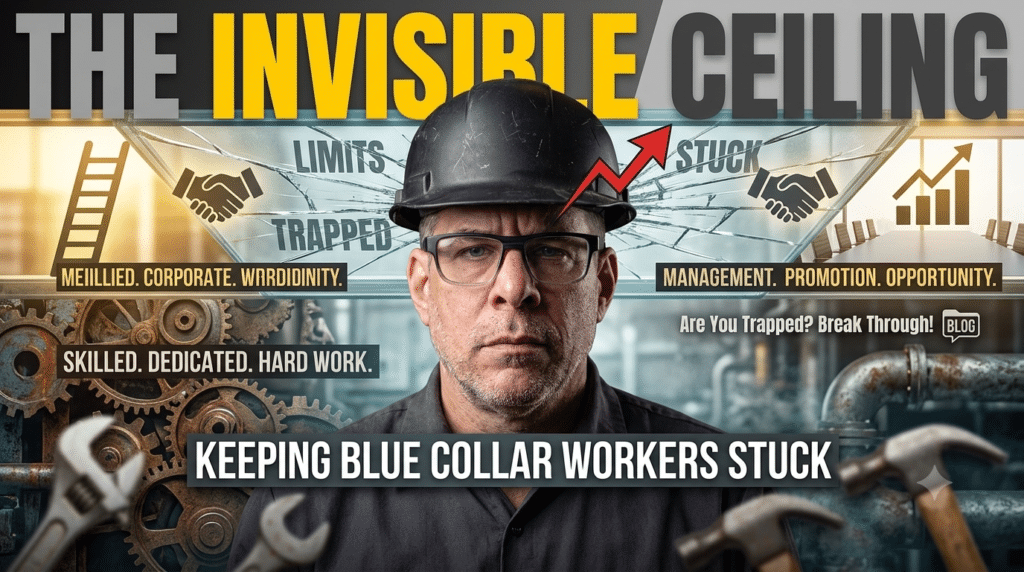
Everybody wants to panic about AI taking over. They think robots are coming for their hard hats, and that automation is going to wipe out the industry. But let me stop you right there. I’m JV Charles, founder and senior editor here at JV CHARLES TV, and after three decades as a union carpenter, project manager, and UAW inspector, I can tell you the brutal truth. The real threat isn’t a computer. It’s The Invisible Ceiling Keeping Blue Collar Workers Stuck at standard journeyman wages while the guy next to them goes on to clear half a million a year.
You aren’t getting replaced by AI, man. You’re getting replaced by the guy who actually bothered to master the basics while you were trying to shortcut your way to foreman.
Key Takeaways
-
The Robot Myth: Technology isn’t your biggest threat. A cracked foundation is. AI can’t bend conduit in a 100-year-old house.
-
The 5 Core Pillars: There are exactly five technical skills separating the $50k laborer from the $150k project manager. Master them, or stay stuck.
-
The Mindset Shift: Technical skills get you in the door. Thinking like an owner (even when you’re just an employee) is what writes the massive checks.
-
The Golden Era: The current labor shortage means massive, unprecedented opportunity for anyone willing to put in the work to master the highest paying skilled trades.
The Chaos of Skipping Steps
Here’s something that drives me absolutely insane on the job site. I constantly see guys who want to jump straight to the money. They hear that a project manager makes $120k, or a general contractor is pulling in $500k, and they want to skip everything in between.
It’s the exact same problem you see in corporate tech. A company buys the fanciest software on the market, drops a million bucks, and then wonders why everything is still a disaster. You know why? Because their internal processes were garbage before the technology showed up. All the tech did was make the chaos happen faster.
The exact same thing happens to blue collar guys. If you don’t know how to properly read blueprints, handing you an iPad doesn’t fix a damn thing. If you can’t estimate material quantities in your head, some fancy app isn’t going to save your job. You are just putting a turbocharger on a broken engine.
I’ve watched first-year guys try to argue about the “best” way to do something when they can’t even set up their own tools. I’ve seen guys with ten years of experience who are fast, sure but they’re sloppy. And being “fast and sloppy” doesn’t get you promoted. It just makes you the guy who creates headaches for everyone else.
What Exactly Is This “Invisible Ceiling”?
Here’s the harsh reality: nobody is going to pull you aside and say, “Hey buddy, the reason you aren’t moving up is because your fundamentals are trash.”
They just stop promoting you. They stop giving you the big jobs. They quietly pass you over for the guy who does the boring stuff right every single time. And you sit there in your truck wondering what he has that you don’t.
I’ll tell you exactly what he has. He has clean fundamentals. That’s the big “secret” to unlocking Six Figures Zero Debt.
The 5 Non-Negotiable Fundamentals of Skilled Trades
Ask ten guys what the “fundamentals” are, and you’ll get ten different answers. Most will say “show up on time and work hard.” Yeah, that’s technically true, but it’s completely useless advice. That’s like saying the secret to basketball is putting the ball in the hoop.
If you want a real shot at high paying skilled trades, you need these five core steps locked down tighter than a drum.
1. True Technical Mastery
I’m not talking about “I watched a YouTube video on it” mastery. I mean, can you do your trade in your sleep? Can you rough in a bathroom without checking the code book? If you’re an hvac tech, can you diagnose a system failure just by the sound of the compressor? If you are five years in and still googling basic procedures, your foundation is cracked. Don’t get mad at me for saying it this is a reality check.
2. Blueprint and Spec Literacy
I cannot tell you how many guys I’ve worked with over the last 30 years who simply cannot read a set of prints fluently. They see the big picture, but they gloss over the notes and the specs. Then they build it wrong and blame the architect. If you can’t read prints like a second language, you will never be a foreman. Period.
3. Math and Estimation (Where the Money Is)
We aren’t talking calculus here. We’re talking about looking at a job and calculating material quantities, labor hours, and costs in your head. Let’s get real for a second: the guys pulling in top-tier plumbers pay aren’t the ones doing the grunt work. They are the ones estimating the work. Estimation is just applied math. If you can’t run the numbers, you are leaving the biggest paychecks on the table.
4. Bulletproof Communication
Your technical skills get you hired. Your communication skills get you promoted. Can you explain a complex problem to a general contractor? Can you give your crew directions without starting a shouting match? Can you explain an issue to a homeowner without drowning them in jargon? This isn’t a bonus skill. It is a fundamental.
5. Documentation and Organization
Nobody wants to hear this one, but guys running massive contracting businesses didn’t get there because they were the absolute best with a wrench. They got there because they tracked their hours, documented their change orders, handled the permits, and kept clean daily logs. If you can’t manage your paperwork, you can’t run a business. If you can’t run a business, your earning potential has a hard cap on it.

The 6th Element: The Ownership Mindset
So, you’ve got the five core skills. But there’s a sixth piece to this puzzle that isn’t a technical skill at all. It’s a mindset.
Most guys think like employees. They show up, do what they are told, and go home. That’s honest work. But the guys who build serious wealth in Trades Careers think like owners long before they ever own a shop.
An employee looks at a job site and asks, “What do you want me to do?” An owner looks at that exact same job site and asks, “What needs to happen for this project to be successful?”
It’s a completely different energy. An employee complains about the schedule; an owner figures out how to make the schedule work. If you start treating the business like it’s your own money on the line, people notice. Opportunities start falling into your lap.
The Golden Era of Blue Collar Work
Here’s why all of this matters right now more than ever. The labor shortage is very real. The old guard is retiring, and there simply aren’t enough prepared young workers stepping up to fill the void.
Companies are utterly desperate for guys who have these fundamentals on lock. The gap between the guy who just “shows up” and the guy who masters the core steps is getting wider every single day. And the wider that gap gets, the more leverage you have.
You aren’t competing against robots. You’re competing against other people’s laziness. Master the fundamentals, use them as a launchpad to stack your specialties, and you will build a career that no algorithm, no layoff, and no recession can ever take away from you.
FAQs
What are the best fundamentals to focus on first?
Start with true technical mastery and blueprint literacy. If you can’t do the physical work flawlessly and understand exactly what the architect is asking for, the math and communication won’t matter yet. Master the craft first.
Does AI really pose a threat to the trades?
In corporate tech? Yes. In the trades? Absolutely not. AI cannot run wire through a crowded drop ceiling, and it can’t diagnose a weird leak behind a 50-year-old drywall setup. Your job is safe as long as your skills are sharp.
How long does it take to move from journeyman to project manager?
It’s not about time; it’s about competence. I’ve seen guys stay at journeyman for 20 years because they refused to learn estimation and documentation. I’ve seen other guys make the jump in 5 years because they aggressively tackled the five core fundamentals and adopted an ownership mindset.
Do I need a college degree to make six figures in the trades?
Not even close. Some of the wealthiest people I know in this industry haven’t stepped foot in a classroom since high school. They built their wealth by mastering their trade, learning the business side, and eventually starting their own shops.
References
-
Charles, J.V. (2026). The Invisible Ceiling Keeping Blue Collar Workers Stuck. JV CHARLES TV.
-
Decades of firsthand field experience: Union Carpenter, Project Manager, and UAW Inspector observations.