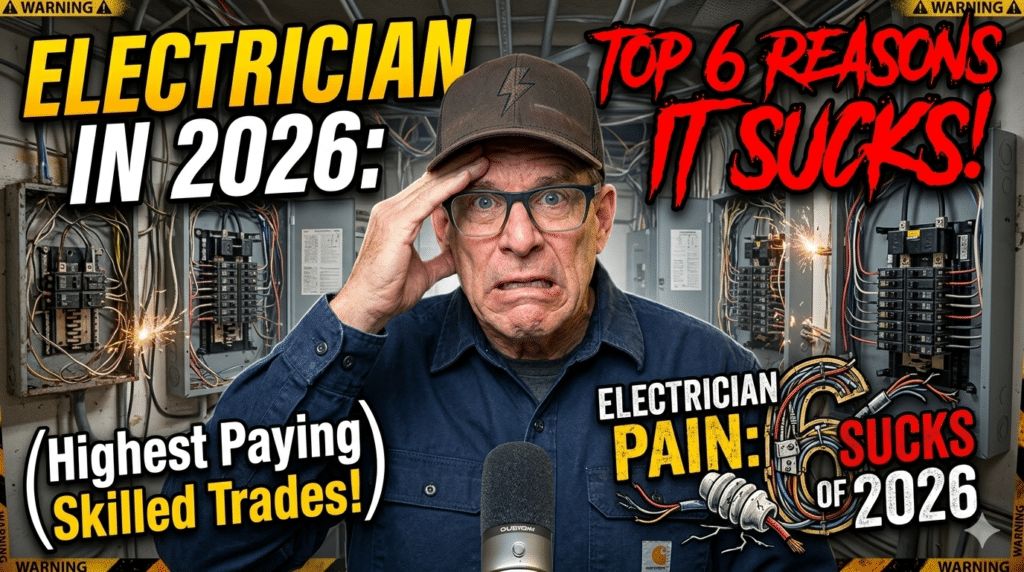
Top 6 Reasons Being An Electrician Sucks In 2026 (Highest Paying Skilled Trades!)
If you’ve been googling “top reasons being an electrician sucks in 2026” while also seeing headlines screaming about the highest paying skilled trades, you’re not crazy. The two things sit right next to each other in the search results for a reason. I’m JV Charles, and over at JV CHARLES TV I’ve spent years sitting down with guys (and a growing number of women) who actually do this work every single day. We talk Trades Careers, blue collar realities, and how regular people are hitting Six Figures Zero Debt without ever stepping foot on a college campus.
Here’s the raw truth: being an electrician in 2026 can absolutely suck in ways that the glossy “earn while you learn” brochures never mention. At the same time, it’s still one of the real high paying skilled trades that can get you to six figures faster than most white-collar paths if you can stomach what the job actually asks of your body, your time, and your sanity.
Before we dive into the six biggest pain points, let’s get the big picture out of the way.
Key Takeaways
- The physical toll is real and cumulative knees, backs, and shoulders don’t forgive years of crawling through attics and yanking heavy wire.
- Your schedule isn’t yours. Overtime and emergency calls own you more often than you own them.
- The danger never fully goes away. One distracted moment can change everything.
- Customers, general contractors, and inspectors can make a hard job even harder.
- Technology and electrical codes are evolving fast in 2026. You’re never truly “done” learning.
- Other trades like hvac and plumber have their own versions of misery the grass isn’t automatically greener, but the trade-offs are different.
If you can handle these six things, the money and the Six Figures Zero Debt lifestyle in the Skilled Trades can be life-changing. If you can’t, it’s better to know now than after you’ve already wrecked your body or your marriage.
1. Your Body Takes a Beating That Shows Up Years Later
Let’s start with the one nobody wants to admit out loud. Electricians crawl, kneel, twist, reach overhead, and muscle heavy stuff all day long. Pulling 500 MCM wire through conduit? That’s basically wrestling an angry snake while bent over in a 110-degree attic. Doing it in February in a crawlspace with frozen dirt and spider webs? Same thing, just colder and darker.
I’ve talked to journeymen in their early 40s who already move like they’re 60. Bad knees from thousands of times going up and down ladders with a tool belt that weighs more than a small child. Lower back issues from years of working bent over at weird angles. Shoulder problems from overhead work that never seems to end on big commercial jobs.
Blue collar work has always been physical, but in 2026 the materials haven’t gotten any lighter and the job sites haven’t gotten any more ergonomic. Some companies are better than others about providing lifts or better tools, but plenty still run the “tough it out” culture. The guys who last the longest either switch to service work (less new construction grunt work) or get into estimating/supervision before their bodies completely give out.
Edge case: If you’re 6’4″ like one of the guys I interviewed last year, tight attics and crawlspaces are pure hell. If you’re on the shorter side, you might dodge some back pain but still deal with the same repetitive stress. There’s no perfect body type for this trade it eventually finds a way to wear on you.
2. The Hours Will Wreck Your Personal Life If You Let Them
Almost every electrician I’ve had on JV CHARLES TV says the same thing: “The money’s good because the hours are bad.”
Overtime isn’t optional on a lot of jobs. New construction has deadlines. Service work means you’re on call when the power goes out at 2 a.m. during a storm. Commercial and industrial sites often run night shifts or weekend work to avoid disrupting operations.
I remember one master electrician telling me he missed his daughter’s high school graduation because a data center project had a critical power-up window. Another guy said his marriage almost ended because he was never home for dinner during the busy season. These aren’t rare stories.
In 2026, with data centers, EV charging infrastructure, and grid upgrades all booming, the pressure for fast turnaround isn’t going away. Some union shops have better rules around hours and overtime, but even then you’re often choosing between turning down money or turning down time with your family.
Compare that to some hvac or plumber roles they have their own emergency calls, but the nature of the work sometimes allows slightly more predictable schedules once you’re established. Not always, but it’s a real difference some guys notice when they’re burned out.
3. The Job Can Literally Kill You (or Maim You) If You Get Complacent
Electricity doesn’t care how experienced you are. One missed lockout/tagout, one bad arc flash, one ladder that shifts at the wrong second, and you’re done or permanently changed.
The Bureau of Labor Statistics still lists falls, shocks, and burns as leading causes of serious injury in the trade. In 2026 we have better PPE, better training, and more arc-flash awareness than ever, but the risk never hits zero. Confined spaces, working at heights, and live troubleshooting keep the danger real.
I’ve heard stories from guys who got “bit” (shocked) badly enough to need hospital time. One described the feeling like getting hit with a baseball bat from the inside. Another watched a coworker fall off a ladder and break multiple bones. These moments stick with people.
The implication? You have to stay sharp every single day for decades. That mental load adds up. Some guys develop anxiety around certain types of jobs. Others just get hyper-vigilant, which is exhausting in its own way.
4. Dealing With People Can Be Worse Than the Actual Work
This one surprises a lot of new guys. The technical part you can learn. The people part? That’s where a lot of frustration lives.
Homeowners who watched three YouTube videos and now think they know better than you. General contractors who want it done yesterday for half the price. Inspectors having a bad day and red-tagging everything. Commercial clients who change the scope three times and still expect the original timeline.
One service electrician told me about a customer who insisted he “just splice it real quick” on a clearly dangerous old panel then got mad when he refused and quoted a proper replacement. Another spent two hours explaining why you can’t just run Romex in a commercial building the way you do in a house.
In 2026 the customer service side hasn’t improved. If anything, more people think they’re experts because of TikTok and Instagram. The electricians who thrive either develop thick skin fast or move into niches (industrial, controls, low-voltage) where they deal with fewer random homeowners.
5. You’re Never Really “Done” The Learning Never Stops
Here’s something the apprenticeship brochures gloss over: electrical work in 2026 is more complex than it was even five years ago.
EV chargers, whole-home battery storage, smart panels, microgrids, data center power distribution, updated National Electrical Code requirements every three years… the list keeps growing. If you want to stay relevant and keep earning top dollar in the highest paying skilled trades, you have to keep learning.
That means continuing education units, new certifications, and time spent studying on your own time. Some guys love the puzzle-solving aspect. Others get tired of feeling like they’re always playing catch-up.
Union programs and good contractors often pay for training, but the time investment is still on you. Miss too many updates and you start getting passed over for the better-paying work.

6. Burnout Is Real, and Switching Trades Doesn’t Always Fix It
After a few years, some electricians look at hvac or plumber work and think “maybe that’s easier.” The truth is every trade has its own special flavor of misery.
Hvac techs deal with 140-degree attics in summer and freezing rooftops in winter, plus the joys of refrigerant and condensate. Plumbers deal with literal human waste, grease traps, and the occasional “I flushed a toy down the toilet” service call. Electricians deal with invisible danger and code complexity.
I’ve had guys on the channel who tried multiple trades. The ones who lasted the longest figured out which specific pain they could tolerate best then leaned into it. Some love the problem-solving of electrical troubleshooting. Others hate it and would rather sweat in an attic doing hvac.
The nuance in 2026? All of these Skilled Trades can get you to Six Figures Zero Debt if you treat them like a real career instead of just a job. The guys making serious money usually own their own truck, have a niche, or run a small company. That path exists in electrical work just like it does in plumbing or HVAC.
So… Is It Still Worth It in 2026?
For a lot of people, yes but only if you go in with eyes wide open.
The median pay sits around $62,000–$68,000 nationally right now, with top earners and business owners clearing well into six figures. Job growth is projected at 9% through 2034 according to the latest BLS data, with roughly 81,000 openings every year. Demand is being driven by data centers, EV infrastructure, renewable energy projects, and aging buildings that need upgrades.
The Trades Careers route still beats a lot of college paths on the Six Figures Zero Debt metric. You get paid to learn instead of paying to learn.
But the six reasons above are real. They’re why some guys last five years and others last thirty. The difference usually comes down to finding the right company or niche, taking care of your body like it’s a tool you’ll need for decades, and deciding early what kind of life you actually want outside of work.
Frequently Asked Questions About Electrician Careers in 2026
Can you really hit six figures as an electrician without going into debt?
Yes. Plenty of journeymen and masters clear $90k–$120k+ with overtime, prevailing wage jobs, or by running their own service business. Union scale in high-cost areas pushes even higher. The key is treating it like a skilled profession, not just clocking in.
How does being an electrician compare to HVAC or plumbing right now?
All three are solid high paying skilled trades in the blue collar world. Electricians often deal with more code complexity and invisible hazards. HVAC techs fight extreme temperatures and attics. Plumbers deal with the messiest conditions. Many guys try one and switch if another fits their personality or physical tolerance better.
Is it too late to start an apprenticeship if I’m in my 30s or 40s?
Not at all. A lot of the best electricians I’ve interviewed started later in life. Apprenticeships pay you while you learn, and maturity can actually be an advantage on job sites.
Will AI or robots replace electricians anytime soon?
Not in 2026 and probably not for a long time after. The work happens in messy, unique, real-world conditions old houses, active construction sites, industrial plants. Troubleshooting and safe installation still require human judgment and physical presence.
What’s the smartest way to get started with zero debt?
Look into union or non-union apprenticeship programs in your area. Many are registered with the Department of Labor, pay increasing wages as you progress, and often include benefits. Avoid expensive private trade schools if you can get into a paid apprenticeship instead.
References
- U.S. Bureau of Labor Statistics. “Electricians.” Occupational Outlook Handbook, last modified August 2025. https://www.bls.gov/ooh/construction-and-extraction/electricians.htm
- ZipRecruiter. “Electrician Salary in the United States (June 2026).” Accessed June 2026.
- Glassdoor. “Electrician Salaries – United States (2026 data).” Accessed June 2026.
- Various 2025–2026 trade publications and market reports on data center construction, EV infrastructure, and skilled labor shortages.