Top 5 Skilled Trades Paying MASSIVE Sign On Bonus In 2026 And Are In HIGH Demand!
If you’re hunting for the top 5 skilled trades paying massive sign on bonuses in 2026 and sitting square in the middle of serious high demand, you just found the right spot. These blue collar skilled trades are handing out real opportunities for a six figure salary with no college degree required and plenty of guys (and women) are quietly building serious side hustles on top of their full-time gigs.
Here at JV CHARLES TV, we’ve spent months talking to journeymen, apprentices, foremen, and contractors who are actually living this right now. The story isn’t just “trades are hot.” It’s that the AI data center boom, grid upgrades, reshoring of manufacturing, and a wave of retirements have created a genuine shortage over 530,000 skilled trade positions sitting empty in construction alone this year. Employers in the hottest markets are throwing out sign-on bonuses, overtime guarantees, and relocation help just to get bodies on site.
The old “go to college or stay broke” script is getting flipped on its head in 2026.
Key Takeaways
- Electricians (especially industrial and data center work) are seeing the biggest action sign-on bonuses of $5,000–$15,000 in key corridors and realistic total earnings of $110k–$150k+ with overtime.
- HVAC technicians working commercial and mission-critical cooling are in short supply; specialists are doubling national averages and companies are offering serious signing incentives.
- Certified welders (pipe and structural) following shutdowns and big projects routinely clear $120k+, with some outfits putting $5k–$6k bonuses on the table.
- Elevator mechanics hold the highest median pay of any major trade often $106k–$110k base, with documented sign-on bonuses reaching $8k–$12k at certain employers.
- Power linemen combine high base wages with storm and emergency overtime that can push annual earnings well past $150k in tough years.
- Every one of these paths starts with no college degree paid apprenticeships or short certificate programs get you earning while you learn.
- Most of these roles leave real room for side hustles evening service calls, small contracting work, mobile welding, or weekend residential gigs.
Let’s break down exactly why these five are standing out in 2026 and what it actually takes to get in.
1. Electricians (Industrial, Commercial & Data Center Focus)
Walk onto any hyperscale data center job right now and you’ll feel the urgency. These buildings are basically small power plants, and they need serious electrical talent for medium-voltage work, controls, and backup systems. Contractors in Northern Virginia, Dallas-Fort Worth, Phoenix, and parts of Texas and Georgia are straight-up offering $5,000 to $15,000 sign-on bonuses for experienced journeymen because they can’t fill seats fast enough.
National median sits around $62k–$63k, but that number is misleading in 2026. In hot markets with overtime and specialty work, commercial and industrial electricians are clearing $110k–$140k, and master electricians running crews on big builds are negotiating $150k+. Union scale (IBEW) plus per diem on travel jobs pushes it even higher.
How to get started with no college degree: 4–5 year paid apprenticeship through IBEW or non-union programs via Associated Builders and Contractors. You earn from day one while racking up the hours and classroom time for your license. Some folks fast-track with trade school plus on-the-job hours.
Side hustle angle: Evening residential service calls, smart home installs, EV charger work, or eventually your own small electrical contracting business. Plenty of guys keep a full-time union or contractor job and run side work on weekends.
2. HVAC Technicians (Commercial & Industrial)
Data centers don’t just need power they need massive, precise cooling. Liquid cooling, immersion systems, and high-efficiency setups are creating demand for techs who understand more than basic residential split systems. Growth is running around 8–9% and time-to-fill for good commercial techs is stretching out.
Base medians hover near $60k nationally, but experienced commercial and controls techs in strong markets are hitting $90k–$125k, with top earners in mission-critical environments pushing higher. Sign-on bonuses show up regularly $2,000 to $15,000 depending on the company and location, plus tools and training packages.
Entry path: 6–24 month certificate or apprenticeship programs, EPA Section 608 certification, and manufacturer training on the newer systems. Many companies will train the right person.
Side hustle potential: Residential tune-ups and maintenance contracts on evenings/weekends, mini-split installs, or building a small service route. A lot of techs eventually spin off their own HVAC company while keeping some commercial accounts.
3. Certified Welders (Pipe, Structural & Industrial)
Welding never really goes out of style, but 2026 is seeing extra heat from data center structural work, LNG and energy projects, manufacturing reshoring, and pipeline maintenance. The American Welding Society has been warning about a massive shortage for years, and traveling pipe welders are still reporting day rates that add up fast.
National median is lower (around $51k–$54k), but that’s not the real story. Specialized, certified welders (AWS, ASME, pipe) doing shutdowns, travel work, or high-spec industrial jobs regularly clear $85k–$140k, with top performers hitting $200k in big years. Some employers are offering $5,000–$6,000 sign-on bonuses plus strong per diem.
How to break in: 6–18 month welding certificate programs, then stack certifications. Union apprenticeships (Boilermakers, Ironworkers, Pipefitters) pay while you learn and often lead to the highest-paying gigs.
Side hustle angle: Mobile welding service for farms, fabrication shops, or custom work (gates, trailers, art pieces). Plenty of welders run a truck and rig on weekends or after hours and make serious extra money.
4. Elevator and Escalator Mechanics
This one consistently ranks as the highest-paying major trade by median wage often $106k–$110k, with the top 10% clearing $149k+. Urban high-rises, mixed-use developments, and deferred maintenance keep demand steady. Some institutional employers are offering documented sign-on bonuses of $8,000–$12,000 (and in other cases $2,500–$10,000) to attract licensed techs.
It’s technical, safety-critical work with strong union protection (IUEC/NEIEP) and solid benefits. Not as flashy as data center electrical, but the pay and stability are hard to beat.
Entry: Highly competitive 4–5 year apprenticeship. You need to be good with your hands, comfortable with heights and tight spaces, and willing to put in the time. High school diploma is the starting point.
Side hustle note: More structured hours and on-call requirements can make side work trickier than electrical or HVAC, but experienced mechanics sometimes do consulting, training, or small independent repair gigs once they’re established.
5. Electrical Power Linemen
When the grid needs upgrading and it does, constantly linemen are the ones climbing the poles and stringing the lines. Storm response work, renewable connections, and data center power feeds keep pushing demand. Median sits around $92k–$95k, but overtime and storm calls can easily push annual earnings into the $140k–$200k+ range in big years.
Utilities and contractors sometimes sweeten offers with signing incentives, especially for experienced hands willing to travel or work storm duty.
Path in: 3–4 year apprenticeship through IBEW or utility programs. CDL is often required. It’s physical, outdoor, dangerous work but the compensation reflects that.
Side hustle reality: Harder to run traditional side work because of scheduled shifts and safety rules, though some linemen pick up private contract or consulting work later in their careers.
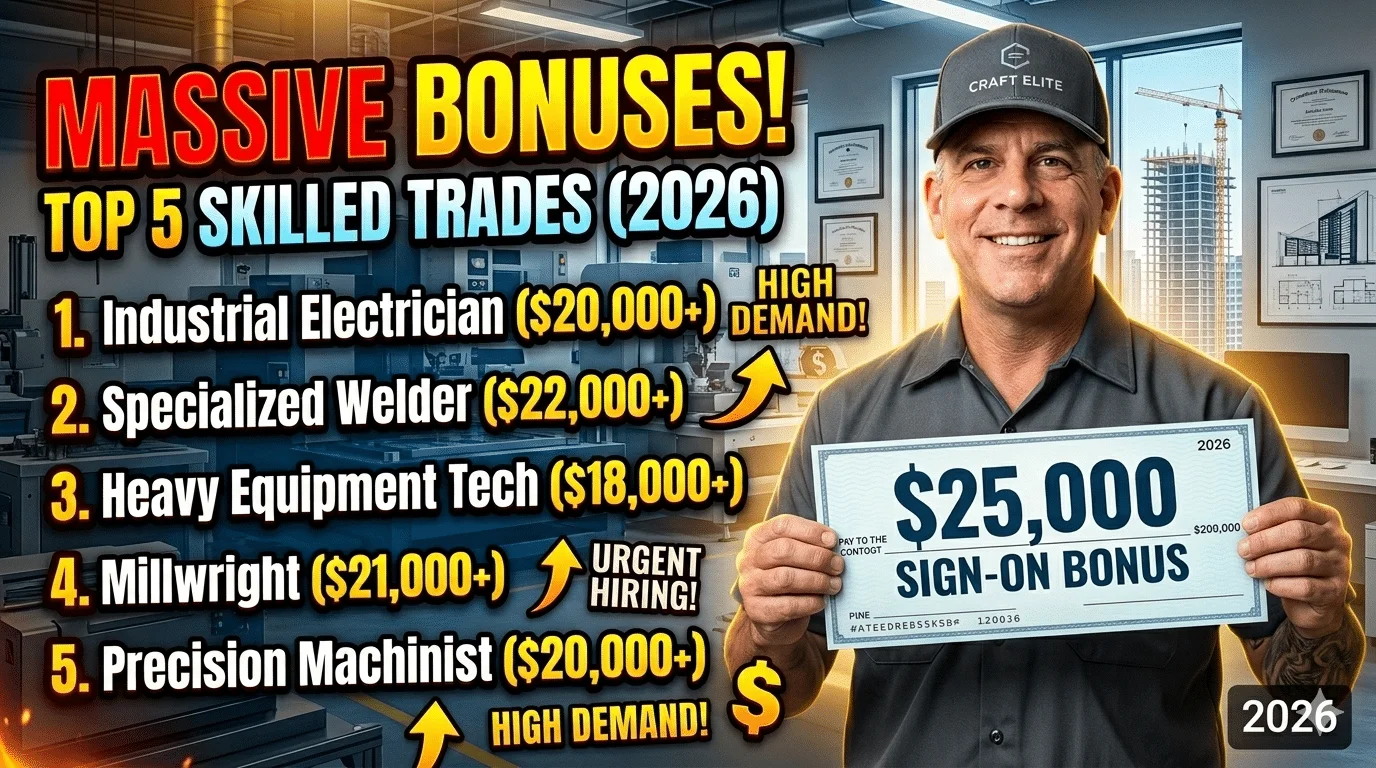
How These Blue Collar Skilled Trades Stack Up in 2026
All five share the same winning formula: paid training paths that don’t require a four-year degree, strong (and in some cases massive) demand driven by infrastructure and technology buildout, and realistic routes to six figure salary territory once you’re journeyman or better. The ones tied closest to data centers and energy right now (electricians, HVAC, specialized welders) are seeing the most aggressive sign-on bonuses and fastest wage growth.
Location matters hot markets pay more and offer better incentives. Union vs. non-union makes a difference on total package. And yes, these jobs are physical. You’ll be on your feet, in the elements, and sometimes in tight or high spaces. But you’ll also finish most days knowing you built or fixed something real.
Getting Started & Building Side Hustles
The fastest on-ramps are registered apprenticeships (paid from day one) and targeted certificate programs at community colleges or trade schools. Google.org just committed $50 million to help train hundreds of thousands more skilled trades workers precisely because of this shortage.
Once you’re working, side hustles are where a lot of guys multiply their income. Common plays include:
- Evening/weekend residential service calls (electrical, HVAC, plumbing-adjacent)
- Small contracting or handyman-style work under your own LLC
- Mobile welding or fabrication
- Specialty installs (EV chargers, smart home, mini-splits)
Many start the side work while still employed full-time, then scale it once they have the license, tools, and reputation.
FAQs
Do I really need experience to start any of these?
No. The best paths are paid apprenticeships that take you from zero to journeyman. Some roles (HVAC, welding) have shorter certificate routes that get you working faster.
How long until I’m actually making six figures?
Realistically 3–7 years depending on the trade, how fast you move through apprenticeship, overtime, and location. Top performers in hot markets hit it earlier.
Is the work as hard on your body as people say?
It’s physical. Knees, back, and shoulders take a beating over decades. Good companies emphasize safety and ergonomics, and many guys stay in the trades into their 50s and 60s by moving into supervision, estimating, or their own businesses.
Are unions worth it?
For many, yes better pay scale, benefits, training, and job protections. Non-union can move faster in some markets but often comes with less security and benefits.
Can women or older career changers succeed in these fields?
Absolutely. The trades need people who show up, work hard, and learn. Plenty of successful stories from career switchers in their 30s and 40s.
What if I don’t want to travel?
Residential and service-side work in most trades stays local. Data center and industrial work is more likely to involve travel or per diem.
Final Word from JV CHARLES TV
The data center boom, clean energy push, and aging infrastructure aren’t slowing down. The shortage of skilled hands is real, and employers are responding with better pay, bonuses, and training support than we’ve seen in years. These blue collar skilled trades aren’t just “good options” anymore for a lot of people they’re the smartest financial move available with no college degree and a clear shot at a six figure salary plus the freedom to build side hustles.
If you’re tired of watching other people get rich while you sit behind a screen, maybe it’s time to grab a hard hat instead.
Drop a comment below which of these five trades are you leaning toward, or what’s holding you back? And if this helped, hit that subscribe button on JV CHARLES TV so you don’t miss the next deep dive into real careers that actually pay.
Stay safe out there, and go build something.
References
- Metaintro – “The AI Boom’s Unexpected Winners: Why Electricians, Welders, and HVAC Techs Are Out-Earning Office Workers in 2026” (April 2026)
- PEAK Technical – “2026 Skilled Trades Workforce Outlook & Comprehensive Report”
- Forbes and Resume Genius analyses of highest-paying blue-collar jobs (2025–2026 data)
- TradeCareerPath and BuildStackHub 2026 salary benchmarks
- Google.org announcement on $50 million skilled trades training initiative (June 2026)
- Bureau of Labor Statistics Occupational Outlook and wage data referenced across 2026 industry reports
- Various employer postings and industry coverage confirming sign-on bonus ranges for electricians, HVAC techs, welders, and elevator mechanics in 2025–2026