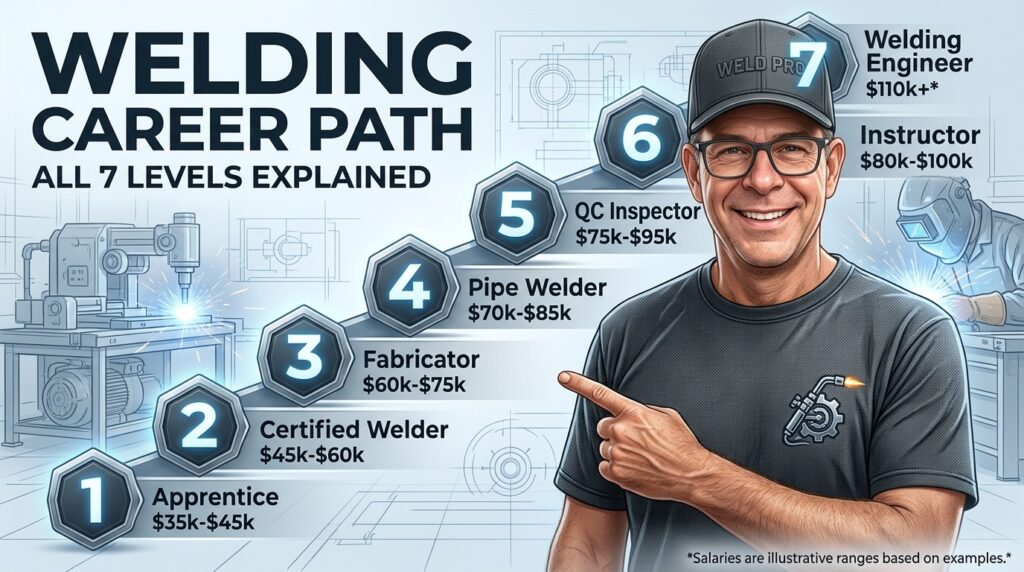
Welding Career Path and Salary: All 7 Levels Explained
If you’ve been searching for a clear map of the Welding Career Path and Salary: All 7 Levels Explained, you’re in the right place. Most guys in the trade never get past the first few rungs because nobody ever handed them the full picture. I’m JV Charles, founder and senior editor of “JV CHARLES TV”, and after more than 30 years in blue collar work from union carpentry to project management to inspecting on the line I’ve watched welders stay stuck at $50k while others quietly cleared six figures. This is the roadmap the industry doesn’t hand out.
Welding sits right in the middle of the strongest Trades Careers and Skilled Trades opportunities available right now. Done right, it can deliver Six Figures Zero Debt. It ranks among the high paying skilled trades and, at the top end, among the highest paying skilled trades. The same logic that drives strong hvac and plumbers pay applies here: certifications, specialization, and willingness to move unlock the money.
Key Takeaways
- National median for welders sits around $53,750 a year (BLS May 2025 data), but the real range runs from the low $30ks at entry to well over $150k–$200k+ in specialized and travel roles.
- Most welders stall at Level 2 or 3 because they never chase the next certification or field experience.
- The biggest pay jumps come from 6G pipe certification, travel/pipeline work, underwater or nuclear specialties, and the AWS Certified Welding Inspector (CWI) credential.
- You can build a full career without a four-year degree and without student debt.
- Ownership at the top end turns a solid trade income into real wealth.
Level 1: Helper / Tack Welder ($30,000–$42,000)
This is where almost everybody starts. You’re the new guy grinding bevels, tacking parts, prepping joints, and running basic MIG in the flat position. Pay usually lands between $15 and $20 an hour. You’re learning the rhythm of a shop, safety rules, and how not to get in the way.
The gatekeeper here is simple: pass your 3G and 4G position tests. Once you can consistently put down solid vertical and overhead beads, shops start treating you like a real welder instead of a helper. Don’t linger. This level has an expiration date if you’re intentional.
Level 2: Certified Production Welder ($42,000–$55,000)
You’ve got your AWS Certified Welder credential. You run MIG, maybe some flux-core, and you’re on steady hours with benefits. Life feels better. A lot of guys park here for years. The money is comfortable enough that the hunger fades.
The gatekeeper is process diversity. Learn TIG. Get solid with stick. Become the combo guy who can handle steel, stainless, and aluminum. That single shift is what pulls you out of pure production work and into better shops and better rates.
Level 3: Specialty / Structural Welder ($55,000–$70,000)
Now the work matters. You’re welding structural steel for buildings and bridges, pressure vessels, or precision fabrications. The foreman knows your name. You might be training the Level 1 guys. Pay climbs into the mid-to-high $50ks and low $70ks depending on location and overtime.
This is the most dangerous level psychologically. It feels like you’ve arrived. The gatekeeper is pipe certification specifically 5G and especially 6G. That one test separates structural shop guys from the people who start making real money. If you’re sitting at Level 3 right now, you’re closer to a big jump than you think.
Level 4: Pipeline / High-Demand Specialist ($70,000–$135,000+)
This is where the game changes. Pipeline, shutdowns, turnarounds, and traveling rig work. You’re no longer in a climate-controlled shop. You’re on the right-of-way in North Dakota in January or on a Gulf Coast turnaround working 12-hour days. Base rates jump hard, and per diem plus overtime push many guys well over $100k.
Union scales in places like UA Local 798 can run in the high $50s per hour before per diem. The gatekeeper is field experience and the network that comes with it. Contractors want guys who can pass a weld test on the spot and show up ready to work. Willingness to travel is non-negotiable at this level.
Level 5: Underwater / Nuclear / Extreme ($80,000–$200,000+)
Now we’re in rare air. Underwater welding (wet or dry hyperbaric), nuclear facility work, and other extreme environments. These roles demand commercial diving credentials on top of top-tier welding skills, or the specialized clearances and procedures required for nuclear work. Pay reflects the risk and the scarcity. Experienced saturation divers and nuclear code welders routinely clear six figures, with the top end going much higher on long offshore or high-security projects.
The gatekeeper is specialized training. Commercial dive school plus welding quals, or the nuclear pathway. Not many people take this route, which is exactly why the money is there.
Level 6: Welding Inspector / Engineer ($70,000–$175,000)
Your back starts talking to you, or you simply decide you want longer-term career longevity. The AWS Certified Welding Inspector (CWI) is the main ticket. After five or more years of documented experience, you sit for the exam. Pass rates hover around 50 percent, so the credential carries real weight.
CWIs and senior inspectors move into quality control, procedure qualification, and oversight roles. Pay commonly sits in the $80k–$110k range, with senior or specialized inspectors (especially in energy or aerospace) going higher. Some transition into welding engineering paths with additional education. The physical demands drop while the responsibility and pay rise.
Level 7: Business Owner ($100,000–$250,000+)
Some of the highest earners I know eventually stop selling their hours and start selling results. Mobile welding, specialty fabrication shops, inspection companies, or pipeline support businesses. The gatekeeper is simply the decision to own. You already have the skills. Now you need systems, customers, insurance, and the willingness to handle the business side.
This level turns a strong trade income into real wealth equipment equity, employees, and the ability to scale beyond what any single pair of hands can produce.

How the Numbers Stack Up in 2025–2026
BLS data puts the national median for welders, cutters, solderers, and brazers at roughly $53,750 a year, with the bottom 10 percent near $39,000 and the top 10 percent around $77,500. That top-decile number understates what specialized and traveling welders actually clear once overtime, per diem, and premiums are included. Pipeline, underwater, nuclear, and CWI roles regularly push past $100k.
Location still matters. Energy states and high-cost coastal markets pay more. Alaska, North Dakota, Wyoming, and parts of the Gulf Coast and Pacific Northwest consistently sit at the high end.
Getting Started Without Going Broke
Trade schools and community college programs run from a few months to two years and cost far less than a four-year degree. Many employers hire helpers and train on the job. Union apprenticeships pay you while you learn. The AWS Certified Welder tests are relatively affordable and deliver immediate credibility. Stack 6G pipe and then CWI when the time is right.
FAQs
How long does it take to reach six figures as a welder?
Many guys hit solid six-figure years within 5–8 years if they chase 6G certification and travel work. Underwater or nuclear paths can get there faster once the specialized training is complete, but they require more upfront investment.
Is welding still a good career in 2026?
Yes. Demand remains steady because infrastructure, energy, manufacturing, and repair work do not disappear. The shortage of highly skilled welders keeps the premium roles well paid.
Do I need a college degree?
No. Certifications, proven skill, and a clean work record matter far more.
What’s the difference between shop welding and field welding?
Shop work is steadier and more comfortable but usually caps lower. Field and travel work pays significantly more and requires greater flexibility and toughness.
Can women succeed in welding?
Absolutely. The work rewards skill and reliability, not gender. More women are entering the trade every year, especially in precision and inspection roles.
References
- U.S. Bureau of Labor Statistics, Occupational Employment and Wage Statistics, Welders, Cutters, Solderers, and Brazers (May 2025 data)
- American Welding Society certification pathways and CWI requirements
- Industry reports and compensation benchmarks for pipeline, underwater, and inspection roles
- Direct observations and conversations with working welders across shop, pipeline, and specialty sectors