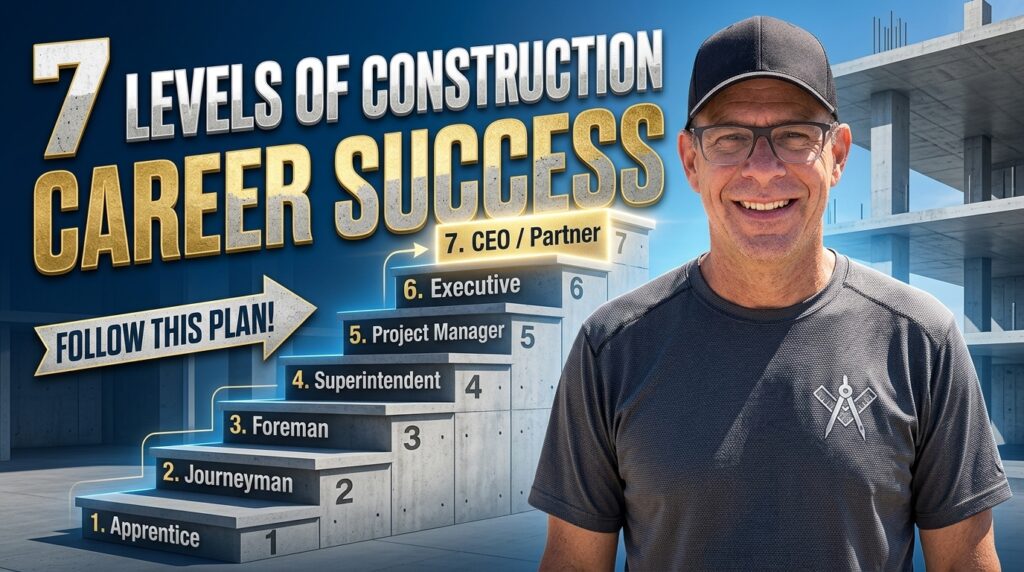
7 Levels Of Construction Career Success- Follow This Plan!
Most guys on the job site only ever see the first three rungs. They think that’s all there is. After more than 30 years swinging a hammer, running projects, and watching men rise or stay stuck, I can tell you the full ladder is a lot taller. 7 Levels Of Construction Career Success- Follow This Plan! is the map I wish someone had handed me early on.
On JV CHARLES TV I break it down the same way every time: the real pay ranges, the gatekeeper at each level that decides whether you keep climbing, and why the people at the top aren’t working harder they just understand the wealth engine most of us never talk about on the site.
Key Takeaways
- Construction has a clear seven-level ladder from day-one laborer to real-estate developer.
- Most people stop at Level 3 (foreman/lead) because they never learn the business side or ask the ownership question.
- Current ranges still hold: laborers often sit $30k–$47k, skilled tradesmen $50k–$80k+, supers and PMs $85k–$170k, and owners/investors well into six figures and beyond.
- The climb does not require a four-year degree. It requires skill, mindset shifts, and deliberate moves at each gate.
- Six figures zero debt is realistic once you pass Level 4 and start treating the work like an ownership path.
Level 1: The Laborer ($30K–$42K)
You show up. Nobody knows your name. They care if you can lift, show up on time, and not quit when it rains or the work gets dirty.
Pay is the lowest on the ladder often $18–$25 an hour depending on the market and whether it’s residential, commercial, or heavy civil. The gatekeeper here is simple: learn a trade. Stay long enough to get noticed by a journeyman who will take you under his wing or point you toward an apprenticeship. Most guys who leave at this level never give the industry a fair shot.
Level 2: Skilled Tradesman ($50K–$80K)
You’ve got a ticket carpenter, electrician, plumber, ironworker, whatever. You’re productive. You can run work without constant supervision.
National numbers for electricians, plumbers, and similar skilled trades still land in the low-to-mid $60k median range, with solid overtime and prevailing-wage work pushing many past $80k. The gatekeeper is mindset. A lot of good tradesmen plateau here because they only think about the next paycheck or the next overtime shift. The ones who keep rising start treating the trade as a platform instead of just a job.
Level 3: Foreman / Lead ($65K–$95K)
Now you’re responsible for a crew. Production, safety, quality, and the daily problems all land on you.
First-line supervisors in construction trades commonly sit in this band, with experienced leads on bigger jobs clearing more. The gatekeeper is learning the business side scheduling, material flow, basic cost awareness, and how to talk to the superintendent or PM without always being on the defensive. Most men stop here. It’s comfortable, the pay is respectable, and the work still feels hands-on.
Level 4: Superintendent / Project Manager ($85K–$170K)
You’re off the tools more than you’re on them. You own the schedule, the coordination between trades, the client relationship on site, and a big piece of the budget.
Construction managers and experienced supers routinely land in the $110k–$150k+ range on commercial and industrial work, with strong markets and big projects pushing higher. The gatekeeper is the ownership question. Do you keep climbing inside someone else’s company, or do you start thinking about building your own? This is where many decide the ceiling is high enough or realize they want more control.
Level 5: General Contractor / Business Owner ($100K–$350K+)
You hold the license. You bid the work, hire the crews or the subs, carry the risk, and keep the profit (or the loss).
Personal income varies wildly with volume, overhead, and discipline, but solid small-to-mid-size operators often clear well into six figures. The gatekeeper is financial discipline. Cash flow, job costing, insurance, bonding, and not spending every good month like it’s permanent these separate the owners who stay in business from the ones who flame out.
Level 6: Build-to-Own Investor ($200K–$500K+)
You’re no longer just building for other people. You’re using the construction knowledge to create assets spec homes, small multifamily, commercial flips, or build-to-rent projects that you hold or sell on your timeline.
Income here comes from both the building profit and the equity growth. The gatekeeper is vision. You have to see the deal before the dirt moves and have the patience (and partners or capital) to wait for the return.
Level 7: The Developer ($500K–Millions)
You’re assembling land, entitlements, capital, and the full project. Construction is one piece of a larger machine. The paydays, when they hit, are life-changing.
Very few reach this level, and it requires relationships, capital access, and the ability to manage risk at scale. The gatekeeper is capital plus relationships. Skill alone is not enough.
How to Actually Move Up the Ladder
Start by mastering the level you’re on. Get the certs, the license, the reputation for showing up and solving problems. Then deliberately study the next gatekeeper.
Talk to people two levels above you. Ask what they wish they had known. Track numbers even when you’re still on the tools—hours, production, material waste. That habit compounds.
Geography, union vs non-union, and specialty (HVAC, industrial electrical, medical gas, data-center work) all move the numbers. Plumbers pay and electrician rates look different in high-cost states or on prevailing-wage projects. But the ladder itself stays the same.

Why Most Guys Never See Past Level 3
Nobody on the job site talks about Levels 5–7 in practical terms. The conversation stays at overtime rates and the next big job. The men who climb further treat construction as a wealth engine instead of just employment. They keep learning the business, protect their body and their reputation, and make deliberate moves at each gate.
I’ve watched ordinary blue collar workers follow this exact path and build lives that look nothing like the “you need a degree” story. The plan is straightforward. The execution is daily.
If you’re early in your trades careers or stuck wondering what’s next, map yourself on this ladder today. Identify the current gatekeeper. Take one concrete step this week. That is how the climb actually happens.
Share this with someone still grinding at Level 2 or 3 who doesn’t know the upper levels exist. And check the full breakdowns on JV CHARLES TV—we keep laying out the real numbers and the real moves that work.
Frequently Asked Questions
Do I need a college degree to reach the higher levels?
No. Most people on this ladder built it through experience, licenses, certifications, and learning the business side on the job or through targeted training.
How long does it take to move from Level 1 to Level 4 or 5?
It varies. Focused people often reach skilled tradesman in 3–5 years and foreman/super roles in 7–12. Ownership timelines depend on capital, market, and discipline.
Is the pay still realistic in 2026?
Yes. BLS and industry data continue to show laborers in the mid-$40k range, skilled trades in the $60k+ medians, supervisors higher, and construction managers often over $100k. Strong markets and specialties push further.
What’s the biggest mistake that keeps people stuck?
Treating every raise or overtime check as spending money instead of building skill, certifications, or a financial cushion for the next move.
Can someone in HVAC or plumbing follow the same ladder?
Absolutely. The pattern is the same across the highest paying skilled trades. Specialize, lead, then decide whether ownership or investment is the next step.
References
- JV Charles TV video breakdown of the seven construction wealth levels
- U.S. Bureau of Labor Statistics Occupational Employment and Wage Statistics (May 2025 data) for construction laborers, trades, supervisors, and managers
- Industry compensation reports and career-path observations from 30-plus years in construction
- Common progression patterns shared by working tradesmen, supers, and owners across residential, commercial, and industrial work