
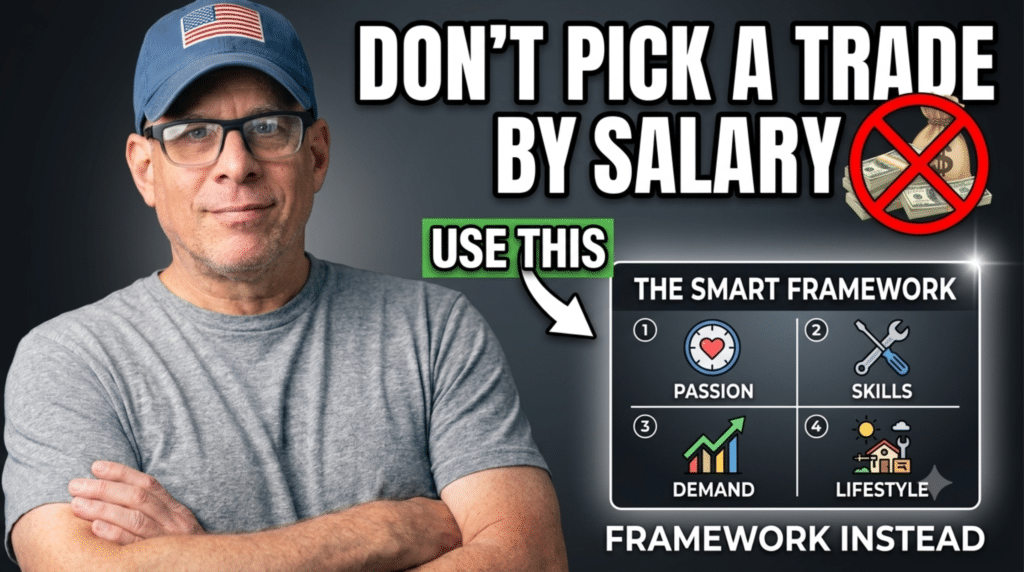
Don’t Pick a Trade by Salary — Use This Framework Instead
If you’re staring at a list of career paths right now feeling completely lost, let me save you a massive headache: Don’t pick a trade by salary — use this framework instead. Every single day, I see guys pull up Google, search for the biggest paycheck, and blindly throw four years of their life into a career they haven’t even seen up close.
And then they wonder why they are burned out, absolutely miserable, or starting from scratch again at 30 or 40 years old.
I’m JV Charles. After 30-plus years climbing the blue collar wealth ladder as a union carpenter, a project manager, and a UAW inspector, I’ve seen exactly what happens when you pick the right path and the absolute wreck it causes when you pick the wrong one. The difference isn’t the trade itself. It’s how you choose it.
We aren’t doing another generic top-ten list today. Instead, I’m giving you the exact five-question framework I would use if I had to start completely over with zero experience, zero connections, and empty pockets.
Key Takeaways
- Chasing the dollar is a trap: A high salary means nothing if the physical toll forces you into early retirement at 45.
- Match the daily grind to your personality: Builders, troubleshooters, and precision workers all thrive in vastly different environments.
- Reverse-engineer your decade: Figure out where you want to end up (business owner, union lifer, specialized tech) before choosing the vehicle to get there.
- Proximity matters: The best apprenticeship in the world is totally useless if it’s not hiring within driving distance of your house.
- Always test the waters: Getting your hands dirty as a helper for a month will teach you more than any internet research ever could.
The Trap of Chasing the Highest Paying Skilled Trades
Here is the mistake that ruins more Trades Careers than anything else: choosing a path based on one single variable.
You look online and see electricians pulling down $80,000 or guys in hvac clearing $90,000. And you know what? According to the Bureau of Labor Statistics, those numbers are dead accurate in a lot of markets. But making the decision entirely based on those figures is a rookie move.
The biggest variable isn’t the starting pay. It’s whether you can actually see yourself doing this exact work every day for the next 10, 20, or 30 years. A job that pays $90,000 but grinds your knees to dust by age 45 is not a $90,000 career. It’s a $90,000 career for 15 years, followed by a frustrating disability claim.
On the flip side, finding a path that pays a solid $70,000 but allows you to work comfortably until you’re 60, keep your body intact, and maybe build a business to retire on your own terms? That is real wealth. Earning Six Figures Zero Debt is entirely possible without destroying your body in the process.
My 5-Question Framework for Choosing a Trade
If I were 18 or 25 again, standing at square one, this is exactly how I would break down my options.
1. What Kind of Work Energizes You vs. Drains You?
I’m not talking about what’s easy. Nothing in the Skilled Trades is easy. I’m talking about the kind of work you can grind at all day and still feel a sense of pride when you pack up your truck.
-
Troubleshooters: Do you love solving puzzles and figuring out why a system is failing? That’s electrical work. That’s HVAC diagnostics. That’s elevator repair.
-
Builders: Do you prefer starting with a pile of raw materials and creating something you can physically touch? That’s carpentry, ironwork, and masonry.
-
Precision Workers: Do you like getting things aligned to a thousandth of an inch? You should look into millwright work, instrumentation, or CNC machining.
-
Movers: Do you hate being in one spot and love the thrill of different cities and challenges every week? Look at pipeline welding or becoming a traveling lineman.
When I started in carpentry, it wasn’t because I looked up the salary. It was because I genuinely loved taking a blueprint and turning it into a finished structure. That satisfaction is what got me through the brutal days.
2. Where Do You Want to Be in 10 Years?
Your trade is just the vehicle. If you don’t know the destination, you can’t properly evaluate the ride.
-
Want to be a business owner? You need a trade with a low barrier to entry. Plumbing, electrical, and HVAC are prime targets. You basically need a van, your license, a phone, and a solid reputation.
-
Want to run big projects? Look at general construction, carpentry, or electrical where the path to superintendent or project manager is crystal clear.
-
Want to be a highly-paid niche specialist? You want to aim for high paying skilled trades like PLC programming, building automation, or wind turbine technician work (which is booming right now).
-
Want total stability? Look hard at the union routes. The IBEW for electricians, the UA for plumbers and pipefitters, or the UAW for auto workers offer pension plans and predictable wage scales.
3. What’s Actually Hiring in Your Area?
The internet might scream that journeyman linemen make $140,000 a year. And with storm work and overtime, they absolutely do. But if you live in a county where zero utility companies are taking on apprentices, that flashy number is completely useless to you.
Before committing, check what’s in your backyard. Call the local union halls. Look up the NCCER (National Center for Construction Education and Research) Career Starter platform. Talk to local community colleges. Don’t fall in love with an idea fall in love with an opportunity you can actually grab.
4. Can Your Body Handle This at 50?
This is the question that separates the lifers from the guys who burn out. Every trade charges a physical tax, but the rates vary wildly.
Roofing in the middle of July will chew up your back. Concrete work will grind down your joints. This doesn’t mean you shouldn’t do them, but it means you need an exit strategy. The guys who survive these trades plan early to transition into estimating, supervision, or ownership before their bodies force their hand.
Other fields like controls, instrumentation, and electrical are far less punishing over a 30-year span. You’re on your feet, sure, but you aren’t hauling 80-pound bundles of shingles up a ladder every morning. Toughness is not a retirement plan. Strategy is.
5. Can You Test It Before You Commit?
Stop guessing. Before you sign your life away to a four-year apprenticeship, go get a job as a helper or a laborer for a local contractor.
You might only make 15 to 18 bucks an hour for a few weeks, but you will learn exactly what the culture is like, what the daily grind feels like, and whether you actually enjoy the environment. Talk to the older guys on site. Ask them what they would do differently. If you spend time researching a topic like plumbers pay online, you’re only seeing the highlight reel. Actually hauling cast iron pipe with a veteran plumber will show you the reality behind the paycheck.

The Smart Way to Break In
If you want to bypass the trial and error, I always recommend looking into resources that streamline the process. Programs like Course Careers are built for this—helping folks transition into in-demand careers without getting buried in college debt. Getting hands-on training and a certificate of completion is how smart tradesmen set themselves up for success from day one.
The Bottom Line on Picking Your Path
If you just chase the highest paying skilled trades blindly, you are playing Russian roulette with your future. Pick your path based on fit. Ask yourself what energizes you, map out your 10-year goal, verify the local job market, protect your future physical health, and test the waters first.
That framework is exactly what separates the guys who build massive, lifelong careers from the guys who are just jumping from job to job.
FAQs
How do I know which trade is right for me?
Look at your natural tendencies. If you love building things from scratch, consider carpentry or welding. If you love solving problems and troubleshooting, electrical or HVAC might be a better fit. Always test the waters as a helper first.
What are the least physically demanding trades?
While all trades require some physical effort, fields like instrumentation, building automation, PLC programming, and low-voltage electrical work take much less of a toll on your joints and back compared to roofing, ironwork, or concrete finishing.
Do I need a degree to get into a trade?
Absolutely not. Most trades use an earn-while-you-learn apprenticeship model. You get paid to learn on the job while completing your classroom hours, allowing you to build a career with zero student debt.
References
-
Bureau of Labor Statistics (BLS): Occupational Outlook Handbook for Construction and Extraction Occupations.
-
NCCER: National Center for Construction Education and Research Career Starter Platform.
-
Lowe’s Foundation: Gable Grants Program for community college and non-profit trade training.
-
JV CHARLES TV: Don’t Pick a Trade by Salary — Use This Framework Instead (YouTube)