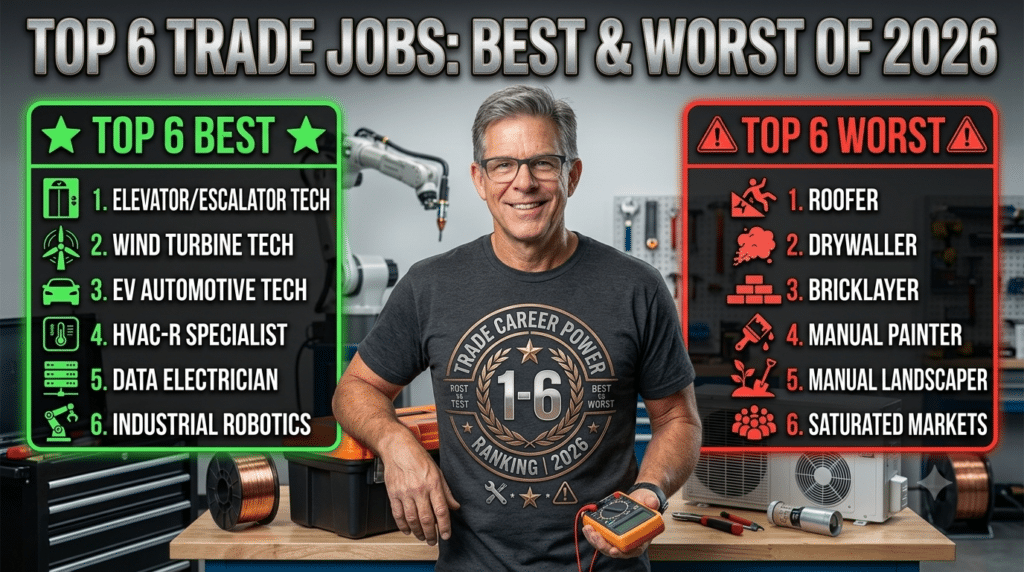
Top 6 Worst and Best Trade Jobs For 2026
Top 6 Worst and Best Trade Jobs For 2026 is the search a lot of guys are running right now, and if that’s what brought you here, you’re in the right place. I’m JV Charles, founder and senior editor over at JV CHARLES TV, and after more than 30 years in the blue collar world union carpenter, project manager, UAW inspector I’ve watched too many solid dudes pick the wrong lane and pay for it with their backs, their bank accounts, and years they can’t get back.
This ain’t another fluffy list pulled from some algorithm. These are the Trades Careers that are actually separating winners from the worn-out in 2026. With data centers exploding, factories reshoring, infrastructure money still flowing, and half the experienced workforce heading for retirement, the gap between the highest paying skilled trades and the ones that’ll cap you out has never been wider.
Here’s the straight truth on which paths give you real leverage and which ones will leave you wondering why you didn’t listen sooner.
Key Takeaways
- Residential-focused, low-skill trades like general labor, drywall hanging, and roofing are getting crushed by competition, thin margins, and brutal physical wear in 2026.
- Industrial and commercial specialties especially electrical, heavy equipment tech, and large-scale hvac are seeing explosive demand from data centers, manufacturing, and critical infrastructure, with experienced hands regularly clearing six figures.
- The real money and longevity come from skills that are hard to replace and tied to systems where downtime costs serious cash.
- You can reach Six Figures Zero Debt in the right Skilled Trades through apprenticeships and targeted certifications no college loans required.
- Physical toll, job security, and earning ceiling matter more than “easy entry” when you’re thinking past age 40.
- Pick leverage over just putting in hours. The trades that reward responsibility and scarcity are the ones printing real money right now.
Why 2026 Changes Everything for Trades Careers
The construction and industrial world isn’t what it was even five years ago. AI infrastructure is driving massive electrical and cooling loads. Ports, rails, and mining are ramping up. Manufacturers are bringing work back stateside. At the same time, a huge chunk of the old heads are retiring and not enough young guys are stepping into the skilled roles that actually pay.
That’s why some high paying skilled trades are about to get even hotter while others stay stuck or get worse. The ones that require real technical knowledge, work on expensive or critical systems, and can’t be outsourced or automated easily those are the ones where guys are naming their price. The saturated residential volume plays? Different story.
I’ve seen both sides up close. Let’s break down the Top 6 Worst and Best Trade Jobs For 2026 so you don’t waste time on the wrong one.
The 3 Worst Trade Jobs for 2026
These are the ones I tell people to think twice about especially if you’re starting later or care about your body lasting past 45.
1. Residential General Labor
This is the classic “go be a gopher on site” role hauling material, demo, cleanup, basic installs. Easy to get into, sure. But that’s the problem. No real specialty, no certification that gives you leverage, and contractors can swap you out with the next guy who shows up. Pay stays capped because there’s always someone cheaper. The work beats on your body every single day with zero ownership or path to real money unless you somehow spin it into something skilled. In 2026, with labor still tight but margins tight too on residential, this lane feels more like a trap than a stepping stone.
2. Drywall Installer (Especially Residential Tape & Texture)
Hanging and finishing drywall is skilled work when you do it right. Problem is, it’s easy enough to learn that crews get huge and competition stays brutal. Residential builders are always pushing for speed over quality, margins stay thin, and you’re on your knees, overhead, breathing dust every shift. Shoulders, wrists, knees, and back take a beating that shows up earlier than you expect. Pay ceiling is low unless you own a big operation, and even then the residential cycle can gut you when rates climb and building slows. Commercial metal stud and institutional work pays better and has more stability, but straight residential drywall in 2026? Hard pass for most guys looking long-term.
3. Residential Roofing Installer
Hot roofs, heights, ice in winter, brutal sun in summer and the pay has never really kept up with the risk or the wear. High turnover, insurance headaches for companies, and younger guys avoiding it entirely. You’re trading your body for volume work that doesn’t scale well for the individual. One bad fall or a few years of that pace and you’re looking at chronic pain with not much to show for it. I wouldn’t touch straight residential roofing as a career move right now. The risk-reward just doesn’t pencil out like it used to.
The 3 Best Trade Jobs for 2026
These are the lanes where the demand is real, the skills are scarce, and the money reflects it. Experienced guys in these spots are hitting Six Figures Zero Debt paths without selling their soul or their health.
1. Industrial Electrician
High-voltage work, PLCs, automation controls, robotics troubleshooting this is the trade that keeps modern factories, data centers, and critical infrastructure running. The AI buildout is creating nonstop demand for guys who can handle complex electrical systems where downtime costs thousands per hour. Shortages are real, overtime is often unlimited when you want it, and the pay reflects the responsibility. Union or non-union, specialized industrial electricians are clearing strong six figures in the right markets and setups. This is one of the clearest highest paying skilled trades plays right now because the work can’t be faked and it can’t be sent overseas.
2. Heavy Equipment Technician
Not the operator in the cab the tech who diagnoses, repairs, and keeps multimillion-dollar machines running. Cranes, excavators, mining equipment, port machinery, railroad gear. These machines cost serious money when they’re down, so good techs with diagnostics, hydraulics, electronics, and software skills are getting paid accordingly. Infrastructure spending, reshoring, and resource projects are keeping the work steady. Field service roles especially can push well into six figures. You can’t outsource fixing a 400-ton excavator on site. That scarcity shows up in the paycheck.
3. Commercial and Industrial HVAC
Big systems in hospitals, universities, factories, data centers, and government buildings. Chillers, boilers, building automation, energy efficiency retrofits this isn’t changing residential filters. Failures here have real consequences, and regulations around energy and critical environments are driving constant upgrades. The work is technical, the contracts are often long-term, and experienced techs with the right certifications are in high demand. hvac in the commercial and industrial space is one of the strongest plays for steady, high-paying work that also tends to be a little easier on the body than pure residential volume once you’re established.
(Quick note: Industrial pipefitting and plumbers pay in commercial or process settings sit right alongside these best options too. The same logic applies critical systems, real responsibility, strong compensation when you specialize.)

How to Actually Break Into These High Paying Skilled Trades the Smart Way
You don’t need a four-year degree or $50k in loans. The winning path is still paid apprenticeships, targeted certifications, and getting on the right job sites early. For industrial electrical or commercial hvac, look at registered apprenticeship programs, manufacturer training, or focused courses that get you the credentials employers actually care about. Heavy equipment tech roles often value hands-on diagnostics experience and specific equipment certs.
The guys winning in 2026 are the ones treating it like a real career from day one showing up, learning the systems that matter, and positioning themselves around the work that can’t be replaced cheap.
Final Thoughts
The Top 6 Worst and Best Trade Jobs For 2026 really come down to one thing: leverage. The trades that put you in front of expensive equipment, critical systems, or complex troubleshooting are the ones rewarding guys right now. The volume residential plays that anyone can learn fast are the ones getting squeezed.
I’ve watched too many good men grind for decades in the wrong spot and end up with nothing but a bad back and regret. Don’t be that guy. Pick the lane where your skills get scarce and your value goes up every year.
If this breakdown helped you see things clearer, drop a comment below with the trade you’re considering or already in. Hit subscribe on JV CHARLES TV for more real-talk breakdowns on Trades Careers, pay, and how to actually build wealth in the blue collar world. And if you want a solid starting point with free intro training options that line up with these paths, check the links in the description.
Choose wisely. Your future self will thank you.
FAQs
Can you really hit six figures in these best trades without college debt?
Yes. Many industrial electricians, heavy equipment techs, and commercial hvac techs clear $100k+ through apprenticeships, overtime, and specialization. The path is earn-while-you-learn, not borrow-while-you-learn.
Which of these trades is hardest on your body long-term?
Residential roofing and drywall take the heaviest toll fastest. Industrial electrical and commercial hvac are still physical but often involve more troubleshooting and less constant brutal repetition once you’re skilled.
Is general labor or residential work ever worth it as a stepping stone?
It can be for a short time while you figure out your real path, but don’t stay there. Use it to get on job sites, then move into one of the skilled specialties fast.
How fast can someone switch into industrial electrical or commercial HVAC in 2026?
Focused training programs and apprenticeships can get you started in months, not years. The key is picking programs tied to actual employer demand in data centers, manufacturing, or critical facilities.
Do unions still matter for these best trades?
In many markets, yes especially for industrial electrical and some heavy equipment or commercial work. They often bring better pay scales, benefits, and training. Non-union can also pay strong if you specialize and perform.
What’s the biggest mistake guys make when picking a trade?
Chasing the easiest entry instead of the hardest-to-replace skill set. Easy entry usually means easy replacement and capped earnings.
References
- U.S. Bureau of Labor Statistics, Occupational Employment and Wage Statistics (May 2025 data) and Employment Projections 2024–2034.
- Industry reports on data center construction, manufacturing reshoring, and infrastructure spending impacts on electrical and mechanical trades demand.
- JV CHARLES TV analysis and field experience across union and non-union commercial, industrial, and infrastructure projects (2026).