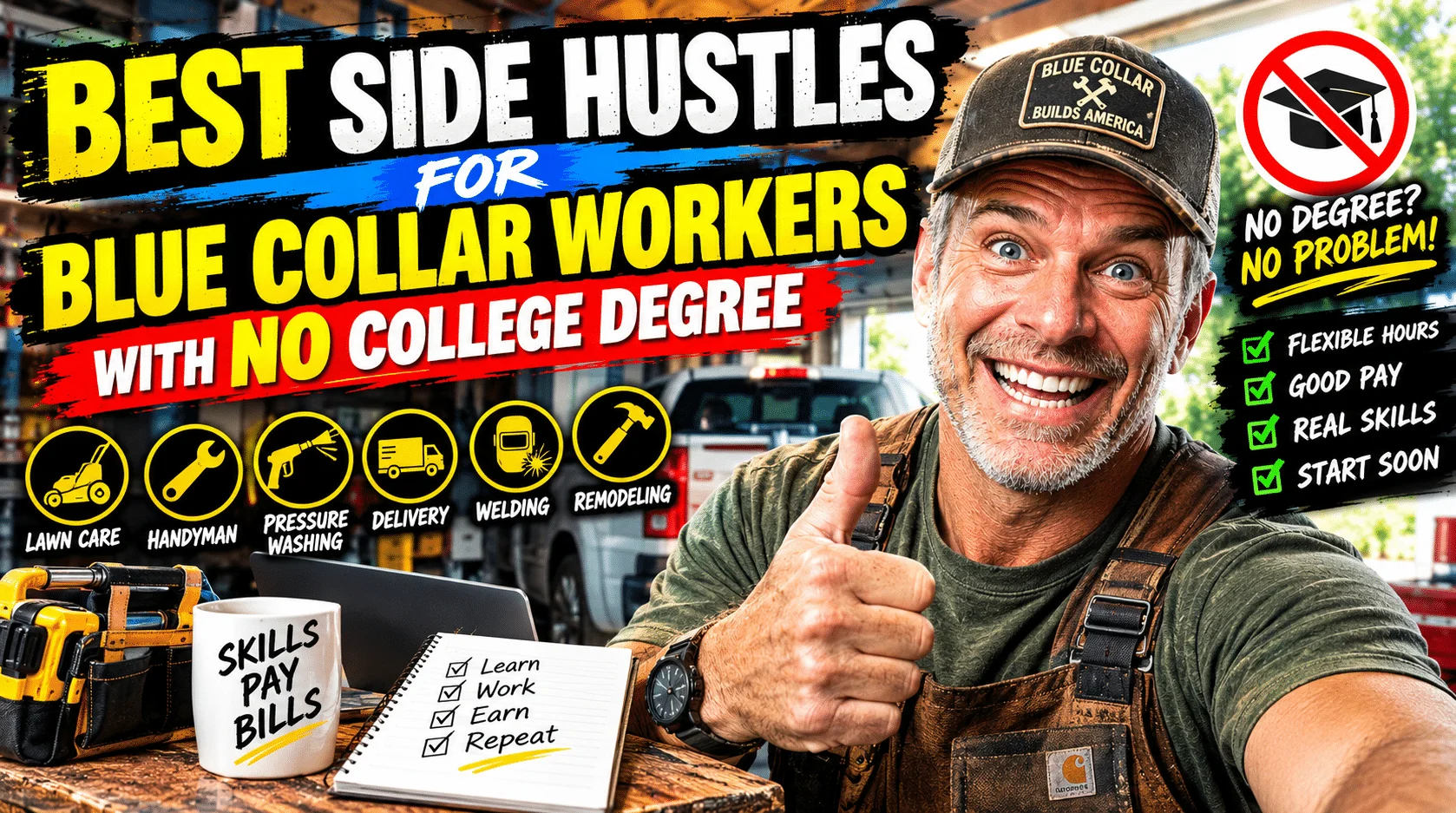

The Degree Bubble Just Popped (And Blue Collar Workers Are Cashing In)
I’m JV CHARLES, founder and senior editor of JV CHARLES TV, and I need to tell you what’s happening right outside your front door: The Degree Bubble Just Popped (And Blue Collar Workers Are Cashing In). I spent over 30 years in the dirt and the dust as a union carpenter, a project manager, and a UAW inspector. For decades, the suits and the guidance counselors told everyone that my path was the wrong choice. They pushed an entire generation into a $1.8 trillion trap of student loan debt. Well, the bill just came due. The bubble didn’t just slowly deflate it violently burst. And the men and women who chose a tool belt over a textbook are standing in the rubble holding all the leverage.
Key Takeaways
-
The Math Flipped: You are looking at a system where a tradesman earning from day one easily beats a graduate drowning in $40,000 of debt.
-
AI is Eating the Cubicle: Artificial Intelligence is wiping out entry-level office jobs, but it cannot crawl under a house to fix a broken pipe.
-
Employers Are Dropping the Degree: Major corporations are actively stripping bachelor’s degree requirements from their job postings. Experience now officially beats the credential.
-
The Shortage is Your Leverage: Baby Boomers are retiring fast, creating an epic shortage that is driving wages into the stratosphere.
The $1.8 Trillion Lie
Back in the 1980s, high schools started gutting their vocational programs. The message was brutal and simple: go to a four-year college or prepare to fail at life. Parents bought it hook, line, and sinker. So, enrollment skyrocketed. And what does any business do when demand becomes practically infinite? They hike the prices.
Today, a typical four-year stint costs an average of $123,000. For a piece of paper. And the kicker? The Federal Reserve Bank of New York just reported that 43% of recent graduates are working jobs that don’t even require the degree they just spent half a decade paying for. We have a generation mixing lattes and folding retail sweaters while carrying a mortgage-sized debt load. This exact setup mirrors the 2008 housing crash overleveraged, overvalued, and totally propped up by easy money.
Why the Bubble Actually Burst
It wasn’t one single event that brought this massive house of cards down. Five massive cracks formed at the exact same time, and every single one of them directly benefits the men and women pursuing Trades Careers.
Crack 1: Corporations Stopped Caring About Degrees
One in four employers is projected to remove bachelor’s degree requirements by the end of this year. Giants like Google, Apple, and IBM already led the charge. The one advantage a college graduate had was that piece of paper acting as a bouncer at the door of the corporate world. Now, the bouncer went home. Experience wins. Capability beats credentials every single time.
Crack 2: The Enrollment Cliff
Sixty-three percent of Americans now openly say a four-year university is not worth the sticker price. People are voting with their wallets. Private colleges are closing their doors or seeing massive enrollment drops. Meanwhile, trade school and vocational enrollment jumped nearly 12%.
The AI Bloodbath and the Blue Collar Shield
Let’s talk about Crack number 3, because it’s the scary one if you’re sitting in a cubicle. AI didn’t just change the game; it absolutely ended it for entry-level white-collar work.
If your job involves basic coding, copywriting, data entry, or customer service, algorithms are doing it faster and cheaper right now. Companies are slashing junior corporate roles.
Why the Trades Are Bulletproof
You know what ChatGPT can’t do? It can’t run fresh conduit through a commercial build. It can’t diagnose a dead blower motor on an hvac unit at two in the morning. It can’t hang drywall. Physical, real-world problem solving is entirely AI-proof. Skilled Trades require hands, sweat, and on-the-ground intelligence that no server farm will ever replicate.
The Leverage Has Shifted Completely
If you want to talk about high paying skilled trades, you have to look at the massive void left by the older generation. This brings us to Crack number 4.
The workforce is aging out rapidly. Nearly 40% of US facility managers over the age of 55 are walking toward retirement. They are taking decades of institutional knowledge with them, and nobody trained a replacement force because we told every 18-year-old to go study psychology.
Right now, the construction industry is screaming for workers. We have a multi-trillion-dollar infrastructure boom happening, data centers being built everywhere, and hospitals expanding. The demand is through the roof, and the supply of workers is in the basement. When you have that kind of leverage, you get to name your price. This is exactly why a seasoned guy can command the kind of plumbers pay that makes a bank manager sweat.

The Real Money Math
Here is Crack number 5. The absolute reality of building a life of Six Figures Zero Debt.
Let’s run the numbers nobody showed you in high school. The college kid spends four years making zero money, racking up $40,000 in debt, and comes out hoping to land a $50,000 gig while paying $400 a month in student loans.
The apprentice? He gets paid to learn from day one. By the time he hits his fourth or fifth year, he’s at journeyman scale, easily pulling in $60,000 to $80,000 a year, with absolutely zero debt hanging over his head. By age 25, the tradesman has a $150,000+ head start in lifetime earnings over the college grad. If he just invested a fraction of that, the compound interest puts him miles ahead financially.
If you want to step into the highest paying skilled trades, the path is wide open. You don’t need a hiring manager’s permission to start your own electrical or plumbing shop. You get your master’s license, you buy a truck, and you own your future. The great lie is finally over. The men in the dirt are the ones truly cashing the checks.
FAQs
Is it really too late for a college degree to pay off?
It’s not that a degree is worthless across the board; it’s that the return on investment (ROI) is completely broken for general degrees. If you are going to be a surgeon or a mechanical engineer, you need the university track. But taking on massive debt for a general communications or business degree when AI is erasing entry-level corporate jobs is financial suicide.
How do I get started if I want to switch to a blue-collar career?
Look into local union halls for apprenticeship programs where you earn an hourly wage while you learn. Alternatively, local community colleges offer incredibly affordable, fast-track certificate programs for welding, HVAC, and electrical work.
Isn’t blue collar work too hard on your body long-term?
It is physically demanding, but the industry has changed. Safety standards, ergonomic tools, and better lifting equipment have evolved massively over the last twenty years. Plus, the goal isn’t to break your back until you’re 65. The goal is to learn the trade, get your license, and transition into ownership, estimating, or project management.
References
-
Charles, J. (2026). The Degree Bubble Just Popped (And Blue Collar Workers Are Cashing In). JV Charles TV. YouTube. Retrieved from https://www.youtube.com/watch?v=f04tbpDmt7Y
-
Federal Reserve Bank of New York. (2025). Labor Market for Recent College Graduates. Economic Research Data.
-
Associated Builders and Contractors (ABC). (2026). Construction Workforce Shortage Reaches Critical Levels. Industry Analysis Report.
-
U.S. Bureau of Labor Statistics. (2025). Occupational Outlook Handbook: Electricians and HVACR Technicians.