The Highest Paying Skilled Trades That Are Replacing White-Collar Jobs (Union Auto Worker Truth)
If you are currently staring at a flickering monitor wondering if your corporate position will survive the next wave of corporate downsizing, you need to understand The Highest Paying Skilled Trades That Are Replacing White-Collar Jobs (Union Auto Worker Truth). Across the country, a quiet revolution is happening right under our noses: thousands of exhausted professionals are abandoning their desk jobs for careers that offer genuine economic leverage, real job security, and massive earning power without a cent of student debt.
Welcome back to JV CHARLES TV. I’m your host, founder, and senior editor JV CHARLES. Today, we are pulling back the curtain on a massive shift in the modern economy. For decades, high schoolers were told that a four-year university degree was the only path to a stable, upper-middle-class life. But look around in 2026. While mid-level corporate managers face constant restructuring and tech workers watch automation rewrite their job descriptions, specialized trade professionals are setting their own rates. Let’s look at the raw data, the union agreements, and the true earning potential waiting outside the cubicle.
Key Takeaways
-
The White-Collar Shift: Physical infrastructure cannot be automated by software. Specialized technical workers are out-earning desk-bound office roles across major metro areas.
-
The Union Blueprint: The UAW contract escalations hitting in 2026 show base wages for industrial skilled trades soaring toward $46 to $50+ per hour, complete with cost-of-living adjustments (COLA).
-
The Debt Advantage: Choosing an apprenticeship over a traditional college degree allows workers to achieve early financial independence with zero student loan liabilities.
The Corporate Realignment: Why Cubicles Are Emptying Fast
The traditional contract between corporate employers and workers is broken. The anxiety rippling through office buildings isn’t an illusion. Massive computational models and advanced software suites are streamlining administrative, marketing, and entry-level analytical work at a staggering pace.
But you cannot download a physical pipe repair. You cannot deploy an algorithm to rewire a hospital’s backup generators or fix a failing chiller plant at a massive data center. The real economy relies on physical assets, and the workforce that builds, maintains, and programs those assets holds all the cards right now. If you want long-term career resilience, entering Trades Careers is no longer a backup plan it’s the ultimate strategic pivot.
The Union Auto Worker Truth: The Blueprint for Massive Earnings
When people talk about the financial upper limit of manual labor, they usually operate on outdated assumptions from twenty years ago. Let’s look at the actual numbers to expose the underlying reality.
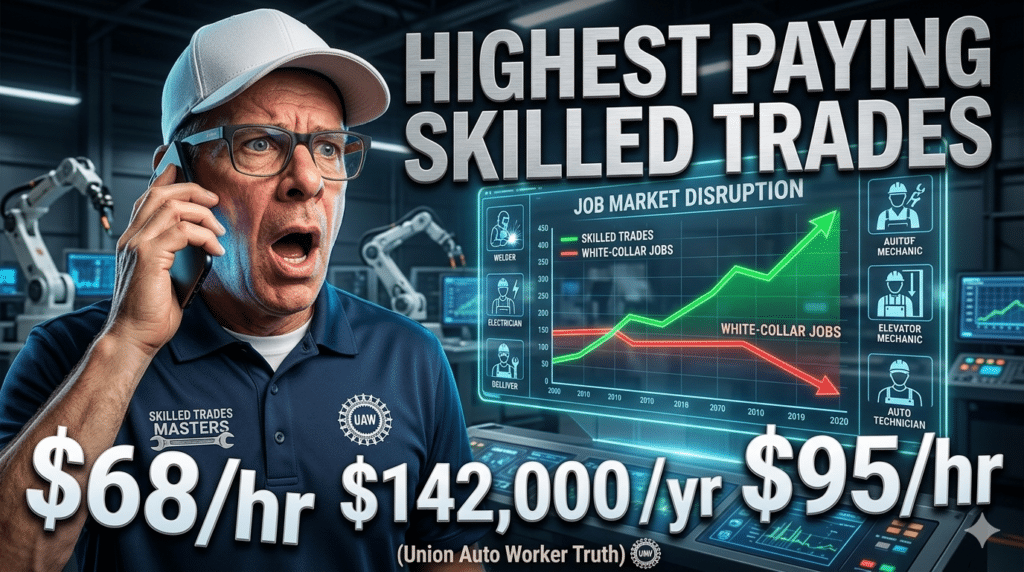
The historic United Auto Workers (UAW) collective bargaining agreements completely altered the wage trajectory for technical personnel. Under the scaled contract milestones hitting active projects in late 2026, a journeyperson in a skilled trade role (such as an industrial electrician, millwright, or tool and die maker) at a major automotive plant sees their base hourly wage jump to over $46.00 per hour.
When you add the contract’s reinstated cost-of-living adjustments (COLA) and consistent overtime availability, these professionals are routinely pulling down $100,000 to $130,000 in straight W-2 earnings. That doesn’t even factor in premium healthcare packages with zero employee premiums and robust profit-sharing checks. This is the baseline reality of the modern blue collar economy. It’s highly technical, heavily protected by collective bargaining, and intensely lucrative.
The Elite Tier: The Highest Paying Skilled Trades Dominating the Market
When people look for the most profitable paths, they often overlook how fast these high paying skilled trades outpace mid-level white-collar salaries. Let’s break down the data on the specific highest paying skilled trades dominant in today’s economy.
1. Industrial Automation & Data Center Electricians
As tech firms expand massive data center facilities to process modern computational workloads, power distribution becomes critical. Industrial electricians specializing in programmable logic controllers (PLCs), high-voltage switchgear, and complex power redundancy systems are commanding premium rates.
-
Experienced Earning Potential: $100,000 – $140,000+
-
The Core Skill: Diagnostics, blueprint interpretation, and automation calibration.
2. Commercial HVAC/R Specialists
Climate control is an absolute operational necessity for modern commercial spaces, medical facilities, and cold-storage distribution nodes. Specializing in commercial hvac systems means managing complex building management software, heavy-duty industrial chillers, and sophisticated variable refrigerant flow systems.
-
Experienced Earning Potential: $90,000 – $125,000
-
The Core Skill: Environmental systems diagnostics, electrical controls, and EPA compliance management.
3. Commercial Plumbing & Heavy Infrastructure Systems
Industrial building booms require comprehensive fluid dynamics management. When you look at heavy commercial infrastructure projects, top-tier plumbers pay routinely hits six figures in high-demand markets like Illinois, New Jersey, and Washington. Master plumbers who handle medical gas lines for hospitals or complex high-pressure steam loops operate at the absolute peak of the market.
-
Experienced Earning Potential: $95,000 – $135,000
-
The Core Skill: High-pressure system welding, commercial code compliance, and hydraulic layout engineering.
Breaking the College Myth: The Math of Six Figures Zero Debt
Let’s look at the financial trajectories side by side. The average four-year university graduate leaves campus carrying a significant financial burden, only to enter a hyper-competitive job market where entry-level salaries struggle to cover the cost of basic rent and loan servicing.

We are talking about achieving Six Figures Zero Debt while your peers are drowning in monthly student loan payments. By the time a trade apprentice reaches journeyman status at age 23 or 24, they already have four years of active retirement contributions, substantial savings, and a specialized license that acts as a permanent insurance policy against corporate downsizing.
How to Successfully Pivot Into the Skilled Trades
Transitioning away from an office desk requires a deliberate strategy. You don’t just walk onto a construction site with a hammer; you treat it with the same professional rigor as any high-level corporate pivot.
Step 1: Target a Specialized Technical Niche
Do not pursue generalized residential labor if your goal is elite compensation. Focus on high-barrier-to-entry specialties that require deep mechanical aptitude, code knowledge, or digital integration, such as automation systems, instrumentation, or commercial chiller maintenance.
Step 2: Contact Your Local Joint Apprenticeship and Training Committee (JATC)
The absolute gold standard for entering the Skilled Trades is a union-backed apprenticeship program. Organizations like the IBEW (Electricians) or the UA (Plumbers and Pipefitters) run local training facilities where mechanical contractors fund your education while paying you an escalating hourly wage for your field hours.
Step 3: Stack Critical Certifications Early
Your earning power is directly tied to your regulatory credentials. Target specialized certifications such as the EPA Section 608 license for refrigerants, OSHA-30 safety compliance, or advanced welding certifications (such as ASME or AWS pipe codes). These credentials immediately signal elite competence to major industrial employers.
Frequently Asked Questions (FAQs)
Are these trade careers physically sustainable until retirement?
Yes, provided you focus on commercial and industrial sectors. Unlike grueling residential framing, high-paying industrial roles center heavily on advanced diagnostics, computerized systems management, and system calibration. Furthermore, experienced journeymen rapidly advance into supervisory, estimating, or project management positions that require minimal physical strain.
How hard is it to find an apprenticeship program?
Competition for union-backed slots can be intense, but the current retirement wave is creating unprecedented openings. Applicants with a strong grasp of basic algebra, mechanical reasoning, and a clean background check are highly competitive candidates.
Do I need to go to trade school before applying?
Not necessarily. While a pre-apprenticeship certificate from a community college can strengthen your application, many union programs prefer to train you from scratch through an integrated earn-while-you-learn curriculum.
References
-
U.S. Bureau of Labor Statistics (BLS): Occupational Outlook Handbook Construction and Extraction Classifications (May 2025 Data).
-
United Auto Workers (UAW): Hourly Collective Bargaining Highlights and Wage Escalation Schedules (2023-2028 Ford/GM/Stellantis Master Agreements).
-
Elite Trade Institute: National Salary Analysis for Commercial Mechanical and Electrical Contractors (2026 Industrial Workforce Report).