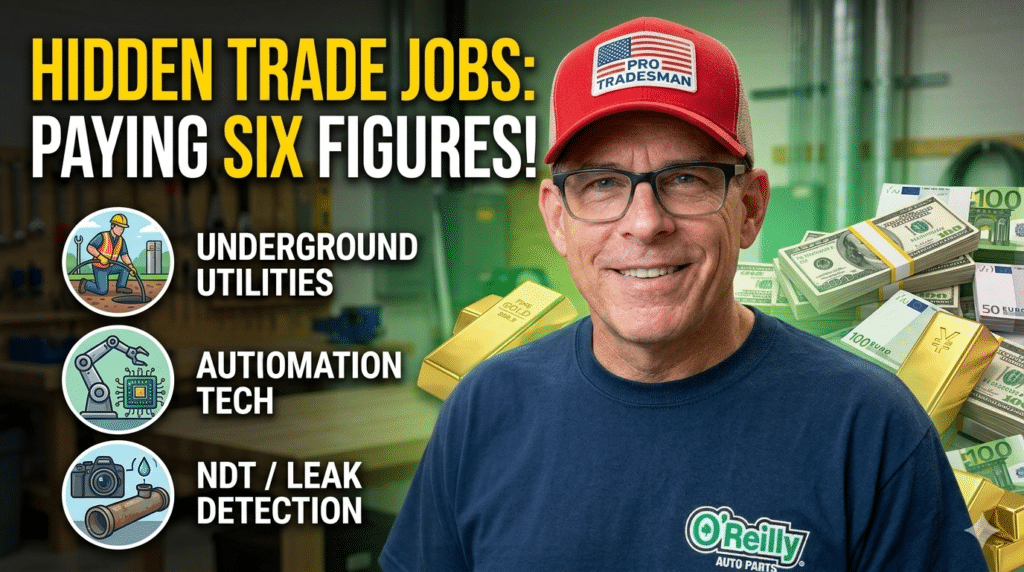
These Hidden Trade Jobs Are Paying Six Figures
These hidden trade jobs are paying six figures, and most people still have no idea they even exist. I’m J.V. Charles. I’ve spent over thirty years in the skilled trades on job sites, in union halls, around generators and switchgear and I can tell you the game has changed. The buildings that run the internet, the cloud, and now all this AI stuff? They don’t build or keep themselves running. Real people with real skills do that work, and right now those people are getting paid like it matters. Because it does.
We dropped a video on the channel late last year breaking down exactly where the money is in data center trades for 2026 and beyond. The response made it clear folks want the details in writing too. So here it is straight, no fluff, and based on what’s actually happening on the ground.
Key Takeaways
- Skilled Trades tied to data centers are some of the strongest High Paying Jobs available right now without a four-year degree.
- Data Center Jobs in electrical, cooling, power backup, and infrastructure are seeing aggressive hiring because AI and cloud demand never slows down.
- You can start in these trades careers through paid apprenticeships or short certification paths earning while you learn instead of paying to learn.
- Several of the highest paying skilled trades in this space already have experienced techs clearing $130k–$200k when you factor in overtime, specialized skills, and emergency response.
- The work is physical and technical, but it’s future-proof. You can’t outsource keeping a 100-megawatt facility online at 3 a.m.
Why Data Centers Turned Into a Goldmine for Tradespeople
Data centers used to be those big, quiet buildings nobody thought much about. Then AI training models started needing massive power and cooling, and suddenly every major player started building or expanding at a pace we haven’t seen before. Downtime on these sites can cost millions per minute, so the people who keep power flowing, racks installed, fiber clean, and backup systems ready get compensated accordingly.
What surprised a lot of folks is how many of these roles don’t need a college degree. They need hands-on ability, willingness to learn systems that are getting more complex, and often the right apprenticeship or certification. That’s the part schools rarely talk about.
The Real Roles That Are Quietly Clearing Six Figures
Here are the ones we see paying the best in data center work right now. These are the hidden trade jobs that don’t always show up on the big “best careers” lists but are moving serious money in 2026.
Server Rack Assemblers & Installers These crews build and set the actual racks that hold the servers some of them weighing over 2,000 pounds. It’s precise, physical work that requires understanding weight distribution, cabling standards, and how everything ties into the building’s infrastructure. Entry-level often starts $60k–$75k. Experienced hands push $90k–$120k. Lead installers who can run crews and handle the biggest hyperscale builds are clearing $150k+. Many come through manufacturing training programs or paid apprenticeships with companies like Dell, HPE, or Cisco partners.
Data Center Electrical Technicians This is the backbone. High-voltage switchgear, UPS systems, generators, and the distribution that keeps everything from crashing. Apprentices might start $55k–$70k while they learn. Journeyman-level techs are in the $95k–$130k range. Senior techs and those who handle commissioning or emergency response regularly hit $150k+. The path is usually an electrical apprenticeship union or non-union plus on-the-job training specific to critical facilities. Military vets with power experience transition especially well here.
Cooling System Engineers & Liquid Cooling Specialists AI servers throw off serious heat. Traditional CRAC units aren’t enough anymore. These techs work on chilled water plants, direct liquid cooling loops, and the complex mechanical systems that keep temperatures stable. Starting pay often lands $70k–$85k. Experienced specialists who understand both air and liquid systems are seeing $110k–$150k, with top hands in the $180k+ range when you add overtime on major projects. HVAC apprenticeships or mechanical maintenance backgrounds are the common entry points.
Fiber Optic Splicers Every data center lives and dies by clean, low-loss connections. These techs splice and test fiber at a level most telecom guys never touch. Entry around $65k–$80k. Experienced splicers who can work clean rooms and hit tight loss budgets push $100k–$140k. True specialists on major builds or troubleshooting critical links can reach $160k+. Short certification programs plus telecom or data center experience get you in faster than most people expect.
Data Center Operations Technicians This is the hybrid role part hands-on, part monitoring. You’re watching BMS and DCIM systems, responding to alarms, doing rounds, and jumping in when something goes sideways. Entry $70k–$90k. Mid-level $100k–$130k. Senior ops leads who can run shifts and make real-time decisions are in the $150k–$200k territory. Trade school, military, or CompTIA-style certs plus mechanical/electrical aptitude open the door.
Fire Suppression System Techs Specialized work installing and testing clean-agent systems (FM-200, Novec 1230, etc.). These systems have to work perfectly the first time. Entry $60k–$75k. Certified techs $90k–$120k. Specialists who know the codes and can handle the most complex facilities push $140k+. It’s niche, regulated, and pays for people who take it seriously.
Structural & Disaster Mitigation Techs Reinforcing buildings against earthquakes, high winds, or flooding with bracing, dampers, and specialized anchoring. Physical work that still requires real engineering understanding on site. Entry around $65k, experienced $100k, specialists $130k+. Often comes from ironworker, welding, or general construction backgrounds that cross over into critical facilities.
Generator & Backup Power Techs When the grid hiccups, these systems have to pick up instantly. Diesel and gas generators, transfer switches, fuel systems all of it. Entry $75k–$80k. Experienced techs $110k–$150k. The ones who can handle emergency response calls and major commissioning hit $180k+. This is one of those roles where being available when things go wrong pays extremely well.
How Regular People Are Actually Getting Into These Roles
Most of these paths start with a high school diploma or GED and then move into a paid apprenticeship or targeted training program. You earn while you learn. That’s the part that still shocks people who grew up hearing “go to college or you’re screwed.”
Electrical and mechanical apprenticeships (IBEW, UA, or independent) remain the strongest on-ramps. Some data center contractors will hire helpers or apprentices and train them specifically on critical power and cooling. Fiber and rack work sometimes move faster through manufacturer or short certification programs. The military remains one of the best feeders guys who already understand power generation and mission-critical environments transition smoothly.
Location matters. Northern Virginia, Texas, Arizona, and parts of the Midwest and Southeast are where a lot of the new builds and expansions are happening. Travel roles with per diem can accelerate earnings fast if you’re willing to go where the work is.

The Honest Side
These jobs pay because the work is demanding. You’ll be on your feet, in tight spaces, sometimes in noisy or hot environments, and often on call or working odd shifts. Safety protocols are non-negotiable one mistake in a live data hall can be catastrophic. Not everyone wants that life.
But for the people who do, the combination of solid base pay, overtime opportunities, specialized skills that keep increasing in value, and actual job security is hard to beat right now. These buildings aren’t going away. The demand for people who can keep them running only grows.
FAQs
Do I really need no college degree for these?
Yes. The majority of these roles are filled by people who came through apprenticeships, trade programs, military experience, or targeted certifications. The hands-on nature makes classroom theory secondary to what you can actually do on site.
How long until I’m making real money?
Many apprentices start earning from week one. The jump to six figures usually happens once you hit journeyman or senior tech level and pick up the specialized data center skills often within 4–7 years depending on how hard you go and which path you take.
Are these jobs stable long-term?
The infrastructure isn’t going anywhere. AI and cloud growth are accelerating, not slowing. Once a facility is built, it still needs operations, maintenance, and upgrade crews for years.
What’s the fastest path if I want to start soon?
Look at electrical or HVAC apprenticeships in your area, or reach out to data center contractors directly. Some of the free intro courses we link in our video description can help you figure out which lane fits your background and location best.
Is the work dangerous?
It can be if you’re careless. Proper training, following lockout/tagout, and respecting the systems are non-negotiable. The pay reflects the responsibility.
If this lines up with what you’re looking for, go watch the full video we dropped on the channel we go deeper on each role and the exact training steps. Drop a comment there or here and tell me which of these eight you’re leaning toward. The work is waiting, and the paychecks are already reflecting how badly these facilities need skilled hands.
Stay safe, keep learning, and remember the people who actually build and maintain the modern world have never had a better time to get paid for it.
References
- JV Charles TV YouTube video “These Hidden Trade Jobs Are Paying Six Figures” (December 2025) – detailed salary ranges and role breakdowns for 2026 data center trades.
- U.S. Bureau of Labor Statistics Occupational Employment and Wage Statistics (May 2025 data) for baseline trade salaries.
- Industry reports on hyperscale data center construction labor demand and wage premiums in 2025–2026 (VoltGrid, contractor surveys, and regional economic development data).
- CourseCareers free intro programs referenced in channel content for apprenticeship and certification pathways.