Underwater Welding Pays More Than Most Degrees And Here’s Proof
Underwater welding pays more than most degrees. And yeah, here’s the proof pulled straight from the real numbers that came out in 2025 and early 2026. Not some cherry-picked headline, but what actual welders, divers, and pay data are showing right now.
A lot of people are quietly walking away from the old college path. They’re looking at Trades Careers that let them hit Six Figures Zero Debt without spending four years and $30k+ just to start from behind. Skilled Trades like this one (and others) are paying better than a lot of desk jobs once you factor in no student loans and getting paid while you learn.
Key Takeaways
- Plenty of experienced underwater welders are clearing $80k–$120k, and the ones who make it to saturation diving on big offshore jobs can push $150k–$250k+ in good years.
- You can get trained and working in roughly 18–36 months for way less money than a degree, and you start earning earlier instead of stacking debt.
- Other high paying skilled trades HVAC, plumber, electrician are also letting people hit strong money without the loan burden.
- Bluecollar work isn’t what it used to be. Shortages are pushing wages up across the board.
- It’s hard, physical, sometimes dangerous work. The big checks come with real trade-offs in your body and schedule.
What This Job Actually Looks Like Day to Day
You’re not just welding. You’re welding underwater on oil rigs, ship bottoms, bridges, pipelines, or offshore wind stuff. Sometimes you’re in the water doing wet welds with special rods. Other times you’re in a pressurized habitat doing dry hyperbaric work that needs to pass the same standards as topside welding.
The skill stack is what makes it pay: commercial diving certification + solid welding quals. Not many people can (or want to) do both at a high level. That’s why the money is there.
The Actual Pay Numbers Right Now
I went through the latest AWS data, BLS commercial diver stats, and what divers are actually reporting. Here’s the picture without the hype:
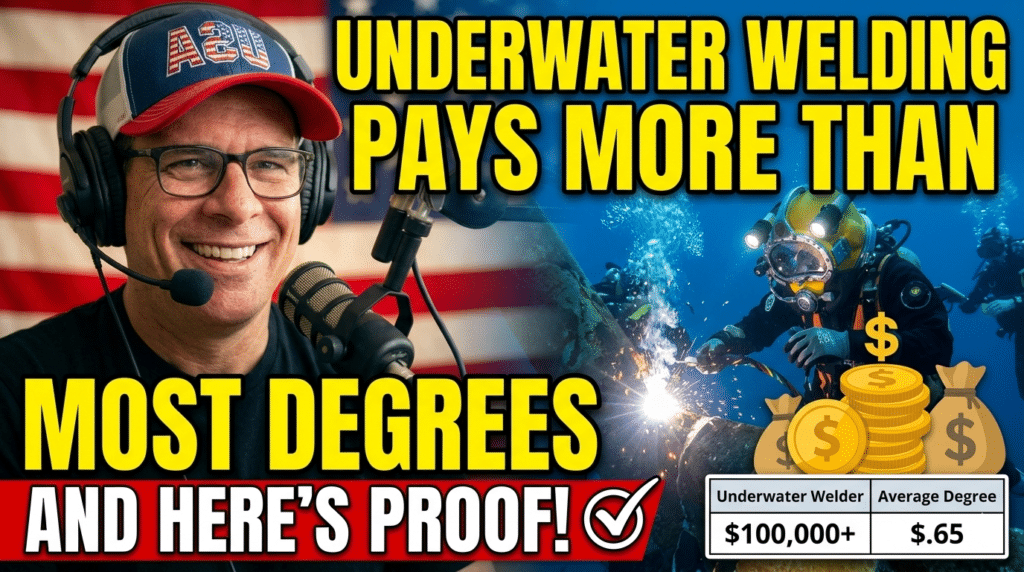
Entry-level or inland work usually starts in the $50k–$70k range while you’re building hours and experience. Mid-career folks who can handle offshore or more technical jobs are sitting in the $80k–$120k zone pretty regularly. The saturation divers the ones living in pressurized chambers for weeks at a time on deep offshore projects are the ones you hear about making $150k–$250k+ when everything lines up with overtime and hazard pay.
Compare that to college. Average debt for a bachelor’s borrower is still hovering right around $29k–$30k. Starting pay for a lot of new grads lands in the low-to-mid $60ks. It takes years to catch up, and you’re paying interest the whole time.
The Six Figures Zero Debt part is real for people who go this route. You skip the big loan and start stacking money sooner.
Other Trades That Are Also Crushing It
Underwater welding is on the extreme end, but it’s not the only game in town. Plenty of other Skilled Trades are letting people do really well:
Plumbers and pipefitters are averaging around $70k–$75k mean, with experienced and self-employed folks easily clearing six figures in the right markets. HVAC techs are in the same ballpark strong demand, good money once you’re licensed and busy, especially if you do refrigeration or commercial work.
Electricians, boilermakers, elevator techs same story. The ones who specialize and show up consistently are making more than a lot of people with degrees. And most of these paths have paid apprenticeships. You earn while you learn instead of the other way around.
The common thread? Bluecollar skills that actually solve problems people will always need solved. No AI is replacing a good welder 80 feet down or a plumber who can fix a flooded basement at 2 a.m.
How People Actually Get Into This
Most start with some topside welding experience and basic AWS certs. Then they go to a proper commercial diving school (ADCI accredited ones are the ones employers respect). Programs run anywhere from 6 to 10 months. After that you chase the underwater welding qualification and start racking up dive hours, usually starting as a tender.
Total cost is usually a lot lower than college, and some places take GI Bill or have financing. You can be working and getting paid within a couple years instead of four-plus.
Same idea for HVAC or plumber routes apprenticeship or shorter trade program, get licensed, and go.

Let’s Be Real About the Downsides
This isn’t “easy money.” The work is cold, dark, physically demanding, and it carries real risks decompression issues, equipment failure, heavy lifting in bad conditions. Saturation diving especially wears on people over time. A lot of guys step back from the deepest work by their 40s.
Schedules are often rotations weeks on a boat or platform, weeks off. You have to stay in shape, pass regular physicals, and be okay with travel and unpredictable weather. Some people love the lifestyle. Others burn out.
Pay also isn’t automatic. The high numbers usually belong to people who’ve put in the years, got the right certs, and are willing to chase the bigger offshore or specialty jobs. Slow seasons happen.
So Who Is This Actually For?
If you’re mechanically minded, don’t mind getting dirty and wet, can handle some risk, and you want to build real earning power without a giant debt anchor this (or one of the other strong trades) might be worth looking at hard.
If you want climate control, predictable hours, and minimal physical wear, probably not. There are other paths.
What I keep coming back to is how many people are realizing the old script go to college, get the degree, figure out the job later isn’t the only (or even the best) option anymore for a lot of folks. Trades Careers are paying, they’re in demand, and they let you keep more of what you earn.
Frequently Asked Questions
How long does it really take to start making good money?
Most people are working within 1–2 years of starting training. The bigger pay jumps usually come after 3–5 years once you’ve got real experience and can take on the higher-paying offshore or specialized work.
Is the training worth it if I might not love being underwater?
Do the research first. Talk to guys who are actually doing it. Some people try it and realize the environment isn’t for them — better to know before you spend the money. Other trades like HVAC or plumber might be a better fit in that case.
Do I need to be a great swimmer or already certified?
No. Commercial dive schools teach you what you need. You do need to pass a pretty thorough physical though. Heart, lungs, ears, and sinuses all get checked.
How do the other trades compare for work-life balance?
Plumber and HVAC work is often more local and steady once you’re established. Less extreme travel than offshore saturation work. Still physical, but different kind of grind.
What if the economy slows down?
Infrastructure, energy, and maintenance work tends to keep going even when other things slow. These aren’t luxury jobs — people and companies always need things fixed and built.
References
- American Welding Society (AWS) career data and Lightcast 2025 figures for underwater welders.
- U.S. Bureau of Labor Statistics OEWS data on commercial divers and other skilled trades (latest available releases).
- Training cost and program details from accredited commercial diving schools.
- College Board and related reports on average bachelor’s degree debt for recent graduating classes.