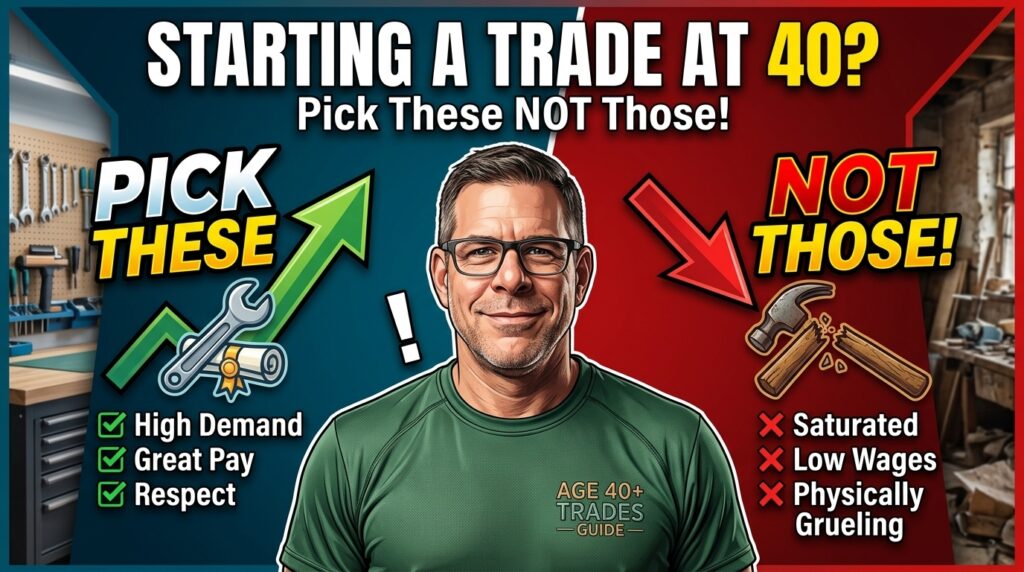
Starting a Trade at 40? Pick These NOT Those!
If you’re staring down 40 (or already past it) and wondering whether Starting a Trade at 40? Pick These NOT Those! is just another motivational slogan or actual real-world advice, let me settle it for you. I’ve watched this exact decision play out for years through JV CHARLES TV. Some guys rebuild their lives and hit solid six figures zero debt. Others wreck their bodies and bank accounts because they picked the wrong lane. Age isn’t the problem. The trade you choose is.
I’m JV CHARLES, founder and senior editor of JV CHARLES TV. I’ve spent enough time around blue collar crews, apprenticeships, and guys making career jumps later in life to know what works and what eats people alive. This isn’t theory. It’s pattern recognition from the field.
Key Takeaways
- Starting skilled trades at 40 is realistic and often smarter than starting at 20 because you bring reliability, customer skills, and financial discipline younger guys usually lack.
- Prioritize skill-and-problem-solving trades over pure physical grind trades.
- Top picks for late starters: plumbing, HVAC, and electrical work. These reward maturity and open clear paths to ownership.
- Avoid high-wear trades like roofing, concrete, and straight demolition if you want a long runway.
- Current BLS data (May 2025) shows solid medians with real upside into six figures once you specialize or go independent all without the college debt load.
- Plumbers pay and related specialties give one of the cleanest routes to six figures zero debt for someone starting later.
Why 40 Is Actually an Advantage in the Right Trade
Most people think the window closes after 35. Wrong. A 40-year-old who shows up on time, talks straight to customers, and understands money has a built-in edge. Shops are short on exactly that. Younger apprentices sometimes need more babysitting. You don’t.
You’re not competing with 22-year-olds on pure speed or recovery. You’re competing on judgment, communication, and consistency. Those traits pay better over a 20-year runway than raw athleticism does.
The math also works differently at this age. You already know how to budget. You’re less likely to blow raises on nonsense. That discipline is gold when you’re building toward six figures zero debt.
The Trades to Pick (These Reward What You Bring)
1. Plumbing — The Clear Number One for Late Starters
Plumbing sits at the top for a reason. National median plumbers pay hit $63,800 in May 2025 BLS data. The top 10% cleared more than $108,420. Growth is projected at 7% through 2035 much faster than average.
Why it fits a 40-year-old especially well: the physical side is real but manageable, the diagnostic and customer work rewards experience, and the path to running your own van and crew is one of the most straightforward in the skilled trades. A reliable, mature person who learns the trade can move into service work and then ownership faster than someone still figuring out life.
You walk into steady demand in almost every market. Residential service, commercial, gas fitting, or specialized pipe work all open doors. Many master plumbers and owners push well past six figures once the truck is theirs and the reputation is solid.
2. HVAC — Fast Entry and Strong Demand
HVAC technicians posted a median of $61,010 in the same BLS release, with the top 10% above $95,210. Projected growth sits at 11% among the stronger outlooks in the trades.
Training can be shorter (certificate plus EPA 608, then on-the-job). Service work leans on troubleshooting and systems knowledge more than pure muscle. Commercial and controls work especially suits people who already know how to think through problems. Overtime during peak seasons is common and can push total compensation higher. Managers and estimators in HVAC regularly clear six figures.
3. Electrical — Knowledge-Heavy and Future-Proof
Electricians came in at a $63,190 median, top 10% over $108,510, with 9% projected growth.
The work rewards careful reading of code, precision, and problem-solving. EV chargers, data centers, and smart systems are only increasing demand. A mature apprentice who shows up reliable and learns the code often advances faster than the average. Service and controls work is less about brute force and more about brains and consistency exactly what a 40-year-old can deliver.
These three sit among the stronger high paying skilled trades and the broader list of highest paying skilled trades that don’t require a four-year degree. Elevator mechanics lead overall medians near $110k, but the entry barriers and specialized apprenticeship make them harder for a pure late starter in many markets. Plumbing, HVAC, and electrical give the best combination of access, pay trajectory, and longevity for someone starting now.
The Trades to Avoid (These Eat the Last Good Decade)
Roofing, concrete, and straight demolition or heavy labor. These are body-tax trades. They demand high physical output day after day with less room for the diagnostic and customer skills that older career changers usually bring. The injury risk is higher and the runway to retirement is shorter if your joints or back start complaining in your 50s.
I’ve seen hard-working guys in these lanes grind themselves out by their late 40s. Effort was never the issue. The trade selection was. If you already have a strong physical baseline and zero joint issues, you can still make them work but the odds and the math favor the skill-based options above.
How to Actually Make the Jump Without Wrecking Your Finances
Apprenticeships remain the gold standard. You earn while you learn. Starting wages are lower (often 40–60% of journeyman scale), but they step up. Many programs have no upper age limit. Trade schools or certificate programs can accelerate entry for HVAC and some electrical paths.
Get licensed where required. Stack certifications. Focus on service and diagnostic work early if pure new-construction labor feels too heavy. Talk to local unions and non-union shops. Reliability is a selling point use it.
The goal for most people in this position isn’t just a paycheck. It’s building a trades careers path that leads to ownership or high-skill specialization so the income compounds without student loans hanging over you. That six figures zero debt outcome is common among people who treat the first few years as the foundation rather than the finish line.

Realistic Timeline and Money Picture
Year 1–2: You’re learning and earning apprentice or entry tech money. It may feel like a step down if you left a higher desk job. Plan for it.
Years 3–5: Journeyman or solid tech rates. Many hit the national medians or better with overtime and location.
Years 6+: Specialization, commercial work, or your own truck. This is where plumbers pay, commercial HVAC, and licensed electrical work routinely push into six figures for people who run the business side competently.
Location matters. High-cost states and metros pay more. Union scales and benefits can change the total package significantly. Ownership multiplies the upside but also the risk treat it like a real business.
FAQs
Is 40 too old to start a skilled trade?
No. Demand is high and maturity is an asset in customer-facing and diagnostic work. Many people begin successfully in their 40s and 50s.
Which trade has the best path to six figures for a late starter?
Plumbing offers one of the clearest routes through service work into ownership. HVAC and electrical also get people there through specialization and management.
How long until I make decent money?
Apprentice pay starts lower but rises. Most people see solid mid-career rates within 4–6 years depending on the trade and local market.
Do I need a lot of physical strength?
Less than pure labor trades. Plumbing, HVAC, and electrical still require fitness, but the emphasis is on skill and problem-solving.
What about debt?
These paths are built for six figures zero debt. Apprenticeships pay you. Certificate programs are short and relatively inexpensive compared with college.
Can I start my own business later?
Yes especially in plumbing and HVAC. Customer skills and reliability you already have become major advantages.
References
- U.S. Bureau of Labor Statistics, Occupational Outlook Handbook and OEWS May 2025 data for plumbers/pipefitters/steamfitters, electricians, and heating/air conditioning/refrigeration mechanics and installers (accessed 2026 data releases).
- BLS employment projections 2025–2035.
- Industry observations and patterns compiled through JV CHARLES TV reporting on blue collar and trades careers.
Starting at 40 is not a consolation prize. In the right skilled trades it is a strategic move. Pick the ones that reward what you already bring reliability, judgment, and the ability to deal with people and you give yourself a real shot at building something that lasts. The wrong pick just accelerates wear and tear. Choose carefully.