Why These Gen-Zers Are Ditching College Degrees For Blue Collar Careers Now
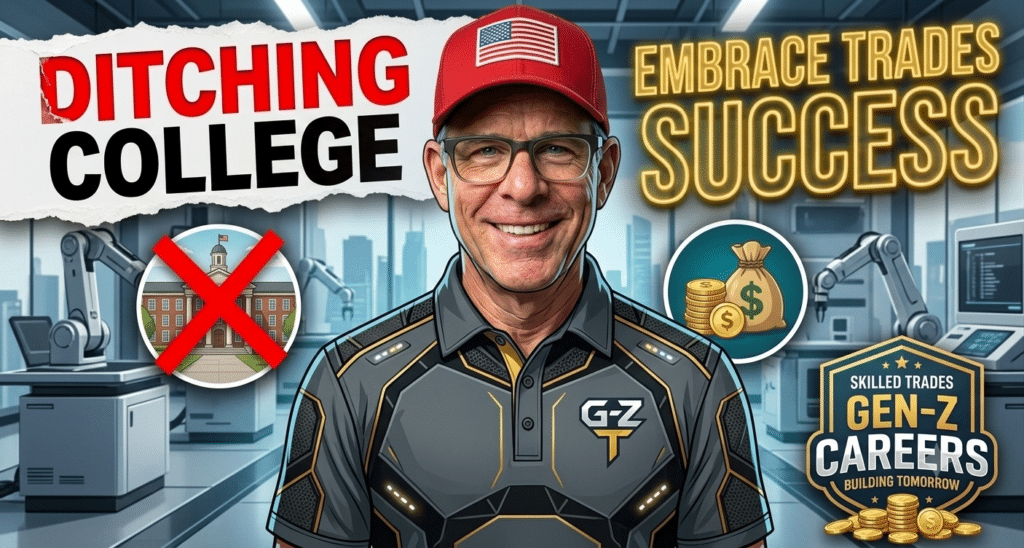
If you have been paying attention lately, you already know the headline: Why These Gen-Zers Are Ditching College Degrees For Blue Collar Careers Now. It is not a passing trend or a social media fad. It is a calculated, data-backed shift that more and more young people are making because the old math simply does not add up anymore.
I have spent more than three decades in Trades Careers. I started with a tool belt and worked my way through the ranks. What I am seeing in 2026 both out in the field and through the conversations on JV CHARLES TV is a generation that is rejecting the traditional four-year path in favor of something faster, more practical, and far less financially punishing. They are choosing Skilled Trades, blue collar work, and real skills that deliver Six Figures Zero Debt outcomes for those who commit.
Here is what the current landscape actually looks like.
Key Takeaways
- 60% of Gen Z respondents in a 2026 Resume Templates survey said they plan to pursue jobs in construction, electrical, hvac, plumbing, and related Skilled Trades this year.
- Vocational and certificate program enrollment jumped 10.2% in spring 2026, while many traditional college programs saw slower growth.
- Average student debt for bachelor’s degree holders sits between $35,000 and $39,000, with many taking 10–12 years just to break even on the investment.
- In high paying skilled trades such as commercial hvac, plumbing, and electrical work, experienced professionals and business owners routinely clear $90,000–$140,000+ annually, often with overtime and without any student loans.
- Apprenticeships let you earn while you learn many start at $35,000–$45,000 in year one and reach journeyman wages well before a college graduate pays off their first semester of loans.
The Numbers That Are Driving the Change
Let us be direct about the economics in 2026. A typical four-year degree from a public in-state university now carries a total cost (tuition, fees, room and board, and lost earnings) that easily exceeds $120,000. Add in average borrowing and the picture gets worse. Many graduates enter the workforce carrying $35,000–$39,000 in debt and start in roles paying $40,000–$50,000 if they find a job that even requires the degree.
By contrast, a motivated person entering a registered apprenticeship or quality trade school program in a high paying skilled trade can be earning from day one. In many union programs, first-year apprentices start in the mid-$30,000s to low-$40,000s while receiving paid on-the-job training and classroom instruction. By the time they reach journeyman status (usually 3–5 years), compensation often lands in the $60,000–$85,000 range before overtime. Top performers and those who move into service work, commercial projects, or start their own companies push well into six figures.
That is the Six Figures Zero Debt math that is resonating with Gen Z.
Why These Gen-Zers Are Choosing Blue Collar and Skilled Trades
The reasons go beyond money, though money is a major factor. Young people today watched older siblings and cousins graduate with debt and then struggle to find stable work. They see artificial intelligence reshaping white-collar roles in real time. They want something tangible work that cannot be fully automated or outsourced to another country.
Trades Careers deliver exactly that. Your local hvac technician, plumber, or electrician is not being replaced by a chatbot. When a pipe bursts at 2 a.m. or a data center chiller goes down, someone with real skills has to show up. That demand is not going away.
Infrastructure legislation, housing needs, data center construction, and an aging workforce retiring out of the trades have created sustained shortages. The Associated Builders and Contractors and other industry groups continue to report hundreds of thousands of unfilled positions. Gen Z is stepping into that gap.
Many are also drawn to the independence. Plenty of tradespeople reach a point where they can run their own service company, set their own hours, and build real equity. I have spoken with 28- and 30-year-olds on JV CHARLES TV who own trucks, employ crews, and clear strong six-figure incomes. That level of autonomy is rare in entry-level corporate roles.
Highest Paying Skilled Trades Right Now: Where the Real Money Is
Not every trade pays the same, and location, specialization, and whether you work union or non-union all matter. Here are the standouts in 2026 based on current wage data and what we are hearing from working tradespeople:
Plumbing and Pipefitting Journeyman plumbers commonly earn $65,000–$100,000. Master plumbers who run service companies or handle complex commercial work frequently clear $120,000–$200,000+. Plumbers pay scales dramatically once you move beyond basic residential service into medical gas, process piping, or owning the business.
HVAC / Refrigeration (especially commercial) Entry-level and residential techs often start in the $50,000–$70,000 range. Commercial hvac technicians with chiller experience, building automation, or data center credentials regularly hit $90,000–$125,000, with overtime pushing some well above that. Senior techs and those who specialize in controls or refrigeration are among the stronger earners in the field.
Electrical (residential, commercial, and industrial) Median wages sit around $62,000, but commercial and industrial electricians in high-demand markets or with union overtime frequently reach $85,000–$140,000. Master electricians and those running their own contracting businesses can exceed that comfortably.
Specialized Welding Structural, pipe, and certified welders in industrial settings, refineries, or shutdown work often earn $75,000–$130,000, with specialized roles (underwater, pipeline, or high-alloy) going significantly higher.
These are the highest paying skilled trades that consistently deliver strong returns without requiring a bachelor’s degree. The common thread is that the top earners treat the trade like a business they pursue additional certifications, seek overtime or prevailing-wage work, and many eventually own their operation.
The Practical Path: How to Actually Get There
The route into these careers is more accessible than most people realize. Registered apprenticeships through unions or non-union sponsors pay you while you train. Many community colleges and private trade schools offer focused programs in hvac, plumbing, electrical, and welding that last 6–24 months and cost a fraction of a four-year degree.
The key is choosing quality training and then committing to the work. The first couple of years are physically demanding and involve learning curves, but the people who stick with it and keep leveling up their skills see the biggest rewards. On JV CHARLES TV we regularly break down specific programs, union vs. non-union differences, and what the day-to-day actually looks like so viewers can make informed decisions.
Real Talk on the Challenges
Blue collar work is not easy. It is physically demanding, the hours can be long, and weather or job conditions are not always comfortable. Your body will feel it after 20–30 years if you do not take care of yourself. That is the honest side.
At the same time, many desk jobs come with their own costs sedentary strain, high stress, and the very real risk that the role gets automated or offshored. The trades offer a different set of trade-offs, and for a growing number of young people those trade-offs are preferable.

The Shift Is Accelerating
Enrollment trends, survey data, and what I hear from contractors and young workers all point in the same direction. Gen Z is not rejecting education they are rejecting education that does not deliver a clear, timely return. They are choosing paths that let them build wealth earlier, avoid crushing debt, and enter fields with durable demand.
Trades Careers are not a consolation prize anymore. For many, they are the smarter, more strategic choice in 2026.
If you or someone you know is weighing options, the data and the lived experience of thousands of tradespeople are worth listening to. The opportunity is real for those willing to put in the work.
Frequently Asked Questions
What is the fastest way to start earning in a skilled trade?
Registered apprenticeships are usually the quickest route. You apply, get accepted, and begin earning on day one while accumulating hours toward journeyman status. Many programs in electrical, plumbing, and hvac have strong demand right now.
Can you really reach six figures without a college degree?
Yes. Plenty of plumbers, electricians, hvac technicians, and welders clear $100,000+ through a combination of base pay, overtime, specialty work, and eventually owning a business. The Six Figures Zero Debt path is proven for those who advance their skills.
How do HVAC and plumbing pay compare in 2026?
Both fields offer strong earning potential. Commercial hvac and refrigeration often edge out on the high end for technicians with advanced certifications, while master plumbers who run service companies frequently post some of the highest owner-operator incomes in the trades.
Is trade work future-proof with AI and automation?
Core hands-on Skilled Trades work installing, repairing, and maintaining physical systems remains highly resistant to full automation. AI may assist with diagnostics or scheduling, but someone still has to turn the wrench on site.
What should I look for in a trade school or apprenticeship?
Look for programs with strong job placement, registered apprenticeship status (where applicable), and connections to actual contractors. Talk to recent graduates and current apprentices. On JV CHARLES TV we cover red flags and what good programs look like.
Do I need to be good at math or science?
Basic math and problem-solving help in every trade. Most programs teach what you need on the job. Mechanical aptitude and a willingness to keep learning matter more than perfect grades.
How physical is it really, and will it destroy my body by 50?
It is demanding. Proper lifting technique, good boots, stretching, and smart career progression (moving into service, estimating, or ownership) help tremendously. Many tradespeople work comfortably into their 60s by taking care of themselves and choosing roles that fit their stage of life.
References
- Resume Templates survey on Gen Z trade interest (2026 data).
- National Student Clearinghouse Research Center, Spring 2026 Enrollment Trends.
- Bureau of Labor Statistics occupational employment and wage statistics for electricians, plumbers/pipefitters, and HVAC technicians (latest available May 2024 data with 2026 projections referenced across industry reports).
- Education Data Initiative and Federal Reserve analyses on average student debt and college ROI timelines.
- Industry reports from Associated Builders and Contractors and Jobber on labor shortages and Gen Z hiring trends.
- Direct insights and wage ranges discussed on JV CHARLES TV episodes featuring working tradespeople (2025–2026).