
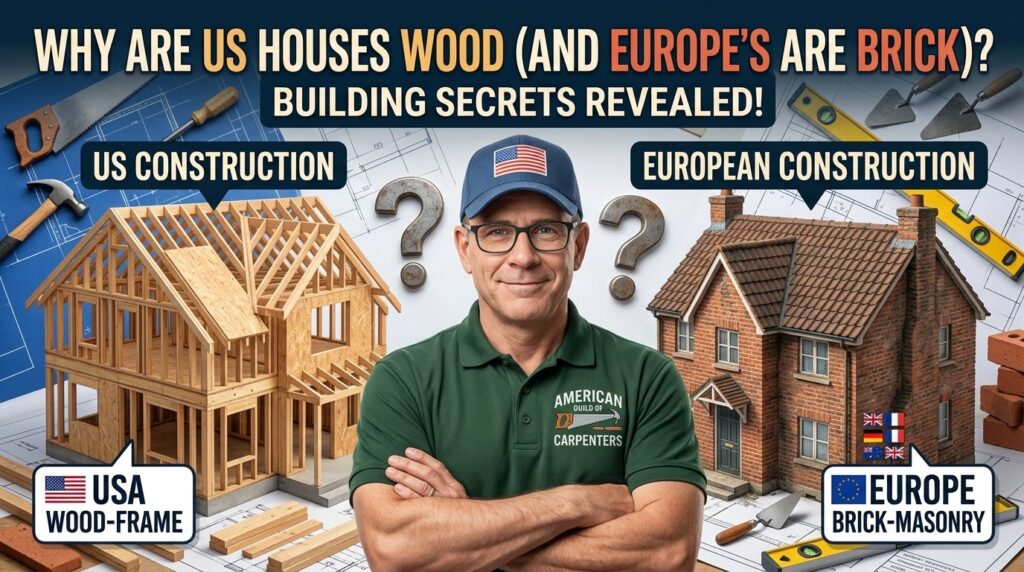
Why Carpenters in US Use Wood to Build Houses (When Europe Use Brick)
Every time this question pops up online, the comments explode. Europeans call American houses flimsy. Americans fire back. And almost nobody answering has ever framed a wall. Why Carpenters in US Use Wood to Build Houses (When Europe Use Brick) is the real answer from someone who’s actually done the work. I’m JV Charles, founder and senior editor of “JV CHARLES TV”, with 12 years as a union carpenter, years as a project manager, and more than 30 years total in blue collar work. American wood-frame construction isn’t the cheap option. In a lot of ways, it’s the smarter one for the conditions we face.
This sits right in the heart of Trades Careers and Skilled Trades. Framing is one of the high paying skilled trades that can lead toward Six Figures Zero Debt when you move into supervision or your own crews. It ranks among the highest paying skilled trades in strong markets, and the same practical thinking that drives solid hvac and plumbers pay applies here: use the material and method that fits the land, the climate, the labor force, and the economics.
Key Takeaways
- North America had (and still has) massive timber resources while Europe was largely deforested centuries earlier.
- The 1833 balloon-frame invention turned ordinary carpenters into high-speed builders and settled the continent.
- Wood-frame homes typically cost $150–$250 per square foot versus $200–$350+ for masonry, and they go up three to four times faster.
- Wood flexes and performs better in earthquakes than rigid brick or block.
- The entire U.S. residential building code system was written around wood-frame construction.
- Over 90% of new single-family homes in the United States still use platform (wood) framing for good practical reasons.
Reason 1: America Had the Trees
When European settlers arrived, they stepped into the largest softwood forest on the planet. Pine, oak, cedar, Douglas fir stretched from the Atlantic to the Pacific. By the 1790s New England alone was exporting tens of millions of board feet every year. Bangor, Maine became the world’s biggest lumber shipping port.
Europe had already cut most of its great forests for ships, fuel, and farmland. Brick and stone weren’t chosen because they were superior. They were chosen because the trees were gone. Resource abundance is still a major reason wood remains practical and cost-effective across most of the United States.
Reason 2: The Balloon Frame Invention of 1833
Before the 1830s, wood houses used heavy timber framing massive posts and beams with hand-cut joinery. It required master craftsmen and a lot of expensive wood. Then a Chicago carpenter figured out something revolutionary. Machine-cut lumber and mass-produced nails had just become cheap. Instead of a few huge timbers, you could nail a lot of lightweight 2×4 studs together.
They called it balloon framing as an insult, claiming the houses would blow away. They didn’t. The system was strong, fast, and could be built by any competent carpenter with a hammer and saw. By 1834 a simple house could be framed in a week. That method (and its modern platform-frame successor) is why America could expand westward so quickly and why more than 90% of new single-family homes today are still wood-framed.
Reason 3: The Math on Cost and Speed
In 2026, wood-frame construction typically runs $150–$250 per square foot. Brick and full masonry land in the $200–$350 range or higher. On a 2,000-square-foot house the difference easily hits $100,000. Speed is even more decisive. A four-man framing crew can raise a standard residential house in days. Bricklayers can only lay so many units per day. Labor hours for masonry are often three to four times higher.
Wood also makes it far easier to run electrical, plumbing, and insulation through the stud cavities. Masonry requires cutting channels and adds complexity at every step. Every attempt to build American housing at scale with solid brick has failed commercially not because brick is bad, but because the economics don’t work for the volume and speed the market demands.
Reason 4: Wood Handles Earthquakes Better
Wood is light and ductile. It flexes. Brick and unreinforced masonry are rigid and brittle. In seismic zones that difference matters. Wood-frame buildings have repeatedly shown better performance in earthquakes because they can move without catastrophic collapse. Codes in high-seismic regions still favor properly engineered wood systems for residential work for exactly this reason.

Reason 5: The Building Code Ecosystem
This is the one almost nobody online mentions. The International Residential Code, state amendments, span tables, fastener schedules, fire ratings, and load calculations that govern American housing were all written around wood-frame construction. The entire supply chain lumberyards, truss plants, sheathing manufacturers, fastener producers, and the labor force is optimized for it. Switching the country to masonry would require rewriting codes, retraining entire trades, and rebuilding the supply system. That’s not going to happen.
The Carpenter’s View
I’ve stood on platform-frame floors, nailed studs to plates, and sheathed walls for years. The internet version that calls these houses “cheap and flimsy” usually comes from people who have never built one. Properly detailed wood-frame homes, with modern sheathing, engineered lumber, proper connections, and weather barriers, perform extremely well. They are easier to modify, faster to dry-in, and far more practical for the way most Americans live and expand their homes.
Europe didn’t choose brick because it is inherently better. They chose it because they ran out of trees and developed a different tradition around stone and clay. America chose wood because it was abundant, because a carpenter invented a system that scaled, and because the math of cost, speed, and performance still works.
FAQs
Do wood-frame houses really last as long as brick ones?
A well-built and well-maintained wood-frame house routinely lasts 50–80+ years and longer. Many older American wood homes are still solid. Masonry often has a longer structural shell life with less maintenance, but both systems can last generations when detailed correctly.
Isn’t wood a bigger fire risk?
Modern codes require fire-rated assemblies, smoke alarms, and in many areas sprinklers. Properly protected wood-frame walls perform well. Masonry is non-combustible, which is an advantage, but the overall fire safety of a house depends on the entire system, not just the framing material.
Why don’t we just switch to brick if it’s “better”?
Cost, speed, labor availability, seismic performance in many regions, and the fact that the entire code and supply system is built around wood make a mass switch impractical. Regional brick veneer over wood framing is already common where appearance or local preference calls for it.
Are European houses stronger?
They are different. Masonry offers excellent mass, sound isolation, and longevity with low maintenance. Wood offers speed, lower cost, easier modification, better seismic ductility, and a lower carbon footprint when sourced from managed forests. Both are rational responses to different histories and conditions.
Is framing still a good trade?
Yes. Residential and light commercial framing remains steady work. Experienced framers who move into supervision, estimating, or running their own crews can reach strong earnings, especially in growth markets.
References
- Historical development of balloon and platform framing and U.S. housing construction practices
- Current 2025–2026 cost ranges for wood-frame versus masonry residential construction
- Seismic performance data and building code frameworks (International Residential Code and state amendments)
- Comparative material and labor studies between North American light-frame and European masonry systems
- Direct experience from 12 years of union framing and project management in residential construction
Wood isn’t the bargain-bin choice. It’s the material that let a continent get housed quickly, that still delivers the best balance of cost, speed, and performance for most American conditions, and that supports one of the core Skilled Trades that built this country. The next time someone online calls American houses flimsy, remember: the carpenters who frame them know exactly why the system works.