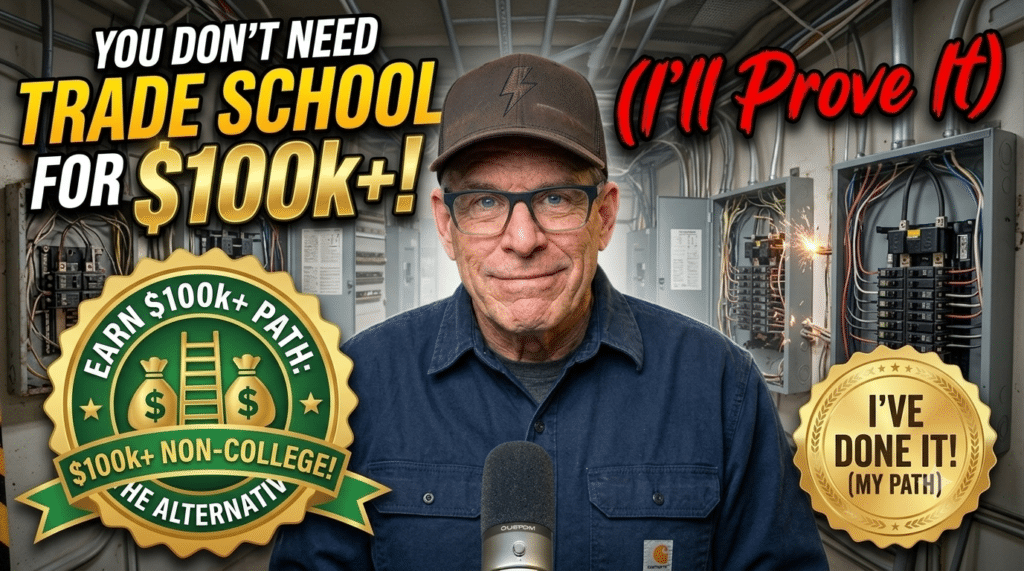
You Don’t Need Trade School For $100k+ (I’ll Prove It)
Hey guys, if you’re scrolling through job listings late at night, staring at those crazy tuition prices, and wondering how some people are out there making real money without a mountain of debt or years stuck in classrooms, I feel you. I’ve been right there myself. I’m JV Charles, the guy behind JV Charles TV, and with more than 30 years grinding it out as a union carpenter, climbing the ladder to project manager, and now working as a UAW inspector, I’ve seen every side of this industry. And let me tell you straight up: You Don’t Need Trade School For $100k+ (I’ll Prove It). No hype, just what actually works in 2026.
I’ve hired people, trained them on job sites, and watched too many good folks get scared off by the old “you gotta pay big bucks for trade school” line. The Skilled Trades world isn’t what it used to be, and if you’re chasing Six Figures Zero Debt in high paying skilled trades or the highest paying skilled trades, there’s a smarter path now.
What You’ll Walk Away With Here
- How to pick up the core stuff online cheap and jump straight into paid work.
- Straight numbers on HVAC, plumbing, electrical, and other solid blue collar options.
- Why bosses care way more about your hustle than fancy certificates.
- Real ways to climb from starting pay all the way to owning your own thing debt-free.
- My no-BS 90-day plan that regular people are using right now.
The Truth About the Old Trade School Trap
Man, I remember the pressure back when I started. You either lucked into an apprenticeship or forked over serious cash for classes. These days? Things have shifted hard. The book smarts part—the codes, safety rules, basic theory, reading prints—you can knock that out from your kitchen table or during lunch breaks without quitting your day job.
Trade schools used to charge $10k or $20k mostly for the building, the instructors’ time, and all that overhead. Now you get the same info online for a fraction. After that, you land an entry-level helper spot and get paid while the real hands-on skills sink in. That’s honestly how these Trades Careers have always been at their best.
Demand is crazy right now for blue collar workers. Infrastructure projects, new builds, repairs on old systems, energy upgrades it’s everywhere. And a lot of these roles let you earn as you go instead of paying to maybe get a shot later.
My Straightforward 90-Day Plan That Actually Works
I laid this out in the video, and people keep telling me it clicked for them. Here’s the deal, broken down simple:
Week 1: Figure Out Your Lane Don’t bounce around trying everything. Think about what fits your life. Like working more from a truck or office? Look at construction project management, estimating, or drafting. Those often start in the $48k–$58k range and build to $75k–$95k pretty steady.
Prefer being out there fixing and installing? HVAC, plumbing and pipefitting, or electrical systems are where a ton of guys and gals are crushing it. Starting pay usually $40k–$48k, journeyman level $65k–$80k, and if you eventually run your own crew? $100k to $200k+ isn’t unusual.
Weeks 2–8: Learn the Foundations Your Way Hit the theory, codes, safety, and systems through good affordable online stuff. No need to blow your savings. You’ll start sounding like you belong when you talk to hiring managers.
Weeks 9–12: Get Out There and Land Something Update your resume with anything even close (handyman work, military background, whatever), apply like crazy to helper and apprentice postings, and show up ready to work hard. Entry level means exactly that—everybody starts at the bottom. The ones who make it are the ones who show up, ask questions, and don’t quit.
What the Money Really Looks Like in 2026
Pay depends on where you live, how bad they need people, and if you chase overtime or specialties, but here’s the real picture from current numbers:
- HVAC techs: Median right around $59k–$65k. Good techs with commercial gigs or their own business push well past $90k.
- Plumbers: Often $61k median to start climbing fast. Experienced ones and masters with their own work regularly see $80k–$100k+, especially with emergency calls boosting plumberspay.
- Electricians: Similar strong track, lots hitting six figures with experience and licenses.
- Standouts like elevator work or certain construction management roles can top $100k faster.
The real money move for a lot of folks is starting their own small operation once they’ve got the skills and contacts. That’s where Six Figures Zero Debt becomes normal life instead of a dream.
Keeping It Real – The Good, the Tough, and the Worth It
This path isn’t lounging around. Some days are hot, dirty, physically demanding. But you get to solve actual problems, see your work last, and build something solid. No wondering if your desk job even matters. Plus, the variety keeps it interesting—different sites, different challenges.
From my hiring days, I can tell you straight: We didn’t care where someone studied. Could they explain basic circuits or pipe runs? Would they show up on time and learn? That’s what separated the keepers.

Folks I’ve Seen Make the Jump
One guy I know came from retail, hammered online HVAC basics while working evenings, landed a helper role, and four years later he’s got his own small crew and a house he bought cash. Another went the electrical route and loves the mix of troubleshooting and steady paychecks. These aren’t unicorns— they’re regular people who decided and followed through.
Wrapping It Up – Your Move
If you’re tired of dead-end stuff and ready for a real shot at high paying skilled trades without the debt, this is it. The old barriers are gone. You’ve got the info—now it’s about doing the work.
Drop a comment with what trade you’re eyeing or your biggest worry. I’ll jump in where I can. And make sure you check the full video breakdown on JV Charles TV. Let’s get you on the path.
FAQs
Do I need experience already?
Most folks start green. Helper positions are designed for that.
What’s realistic pay in HVAC or plumbing?
You can hit decent money quick, but the bigger jumps come with a couple years in and smart moves like certifications or business ownership.
Is this smarter than college for a lot of people?
For hands-on types who want to earn fast and stay practical? Yeah, often it is.
Licenses and certs?
They come as you go, usually through the job or low-cost programs.
Works for women or folks switching careers later?
100%. Attitude and reliability beat everything else.
References
- My JV Charles TV video on this exact topic (Feb 2026)
- Latest BLS and industry salary reports
- Real stories from folks in the trades right now