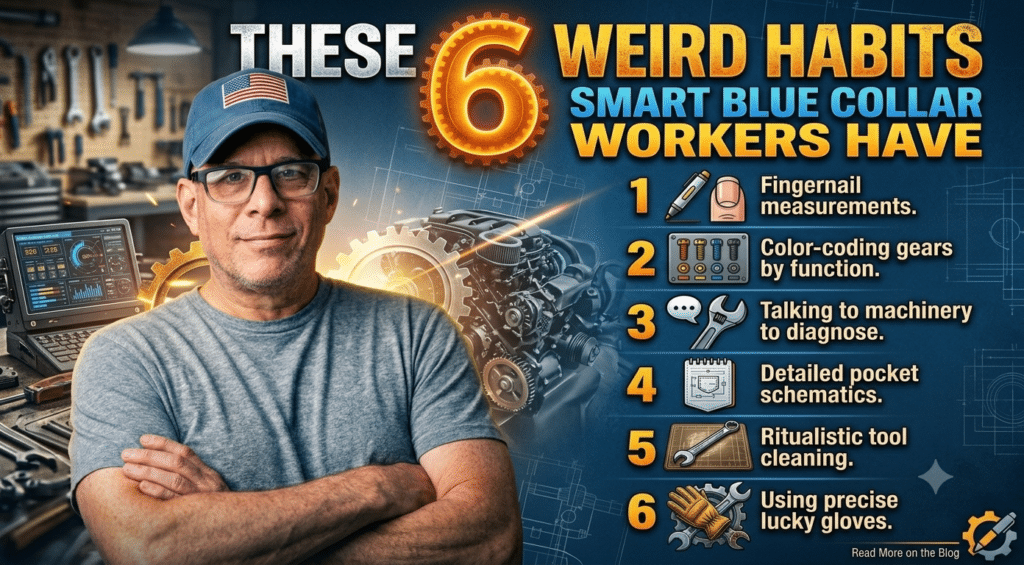
These 6 Weird Habits Smart Blue Collar Workers Have
Hey guys, JV CHARLES here, founder and senior editor of JV CHARLES TV. Have you ever noticed that the smartest guy on your crew is usually the one everybody thinks is a little off? Today, we are talking about These 6 Weird Habits Smart Blue Collar Workers Have.
I’ve spent over 30 years working in blue collar jobs, and I can tell you firsthand that the guys pulling down Six Figures Zero Debt aren’t the “normal” ones. They are the ones wired entirely differently. They are the guys running the company someday, hitting the highest tax brackets, and walking through their front doors every night knowing they outworked and outthought everyone on the job site.
Key Takeaways
-
Being “awkward” is often a sign of high intelligence: Forgetting names or hating small talk just means your brain prioritizes real data.
-
Solitude breeds problem-solving: Eating lunch alone helps you recharge and prep for the afternoon grind so you aren’t burnt out by 4 PM.
-
Adaptability beats stubbornness: Changing your approach mid-job stops callbacks and keeps clients happy.
-
Dark humor is a survival tool: Cracking a joke when a pipe bursts is actual emotional resilience.
Why Being “Weird” Actually Pays Off
The normal guys on the site usually stay exactly where they started. But the guys building real wealth in Trades Careers? Your crew probably thinks they’re antisocial, difficult, or just plain weird. Turns out, science backs up every single one of these oddball behaviors as a sign of higher cognitive ability. Let’s break down why.
Habit 1: You Forget Names But Remember Everything Else
You meet a new contractor on the site. You shake his hand, and five minutes later, his name is gone. But three weeks down the line, you remember exactly what he said about the spec issue on the second floor.
Your crew might think you’re rude, but you aren’t. Your brain is simply prioritizing substance over labels. Research actually shows that people with higher cognitive ability focus heavily on deeper information rather than surface details. A name is just a tag. Everything else is data your brain decided was worth keeping.
Habit 2: You Eat Lunch Alone in Your Truck
Everybody else is hanging out at the tailgate or gathered in the breakroom, but you’re sitting in your truck with your headphones on. Management thinks you aren’t a team player.
Here’s the reality: a massive study published in the British Journal of Psychology found that highly intelligent people actually get less satisfaction from socializing. Your brain generates enough stimulation on its own. While the social butterflies are burning themselves out, you’re mentally solving the afternoon’s problems. By 3:30 PM, when everyone else is dragging ass, you still have energy left for your kids.
Habit 3: You Question Everything the Foreman Says
The foreman tells the crew, “Do it this way.” Everyone blindly grabs their tools, but you stop and ask why. You aren’t trying to be a pain in the neck. You genuinely need to know if this is actually the best approach or if it’s just “the way it’s always been done.”
Higher intelligence correlates directly with skepticism and challenging assumptions. Your brain is literally built to scan for flaws. Every foreman who eventually became a superintendent, and every guy who started his own company, questioned the process first.
Habit 4: You Change Your Mind Mid-Job
This one drives people crazy, but it’s what separates the amateurs from the pros in Skilled Trades. You start a task, and halfway through, something feels off. So you stop, rethink, and completely change your approach.
Your crew might call you indecisive. But smarter people treat every method as a hypothesis, not a blood oath. If you’re working in hvac or electrical, catching a problem before the client sees it is the difference between a clean finish and a nasty Saturday morning callback. Accuracy builds reputations, and reputations feed families.
Habit 5: You Can’t Stand Small Talk
Someone asks how your weekend was, you say “fine,” and then there’s an awkward silence. You aren’t trying to be cold. Your brain just naturally rejects conversations that carry zero valuable information. Small talk is the verbal equivalent of empty calories.
When you do connect with someone, it goes deep and it goes fast. In high paying skilled trades, those deep, no-bullshit connections are exactly what get you hired, get you solid referrals, and build a client base you can rely on.
Habit 6: You Laugh at Dark Humor
Something goes massively wrong. Equipment completely fails, the schedule blows up, everyone is stressed out of their minds and you crack a dark joke.
According to researchers at the Medical University of Vienna, people who appreciate dark humor score way higher on intelligence and emotional control. It takes multiple fast cognitive steps to process a disaster and find the humor in it simultaneously. It’s essentially cognitive jiu-jitsu. You take something incredibly heavy and flip it into something light. It keeps the crew from panicking and stops you from bringing that stress home to your family.

Finding Your Path in the Trades
Knowing your brain is wired differently is only the first step. Choosing the trade that actually matches how you think is where most people get tripped up.
Don’t Let Them Call You Crazy
They called you weird, but it turns out you were just wired for something bigger. If you have at least three of these habits, you’re probably the guy who catches problems before they happen. You’re the guy whose clients ask for you by name.
Matching Your Brain to the Job
If you’re serious about taking your income to the next level, you need to align your natural intelligence with the right career path. Some guys are built for complex electrical diagnostics, while others thrive pulling down massive plumbers pay by out-thinking emergency pipe failures. Whatever path you take, aim for the highest paying skilled trades out there. Trust your brainit knows exactly what it’s doing.
FAQs
Why do smart tradesmen prefer eating alone?
Eating alone allows highly intelligent workers to decompress. Their brains generate high levels of internal stimulation, so they use lunch breaks to mentally plan the rest of the day instead of burning energy on small talk.
Is it bad to question a foreman on a job site?
Not necessarily. While it might annoy bad management, smart workers question things to understand the “why” and find more efficient methods. It’s a sign of critical thinking, not disrespect.
Why do clients prefer tradesmen who change their minds mid-job?
Because it prevents mistakes. A smart worker will stop and adjust their approach if something isn’t right, which leads to zero callbacks and higher quality work.
Does dark humor actually mean you’re smarter?
Yes. Studies show that processing dark humor requires complex cognitive functioning and emotional control, helping tradesmen handle high-stress situations without panicking.
References
-
Kanazawa, S., & Li, N. P. (2016). The savanna theory of happiness. British Journal of Psychology.
-
Willinger, U., et al. (2017). Cognitive and emotional demands of black humour processing: the role of intelligence, aggressiveness and mood. Cognitive Processing.
-
Mehl, M. R., et al. (2010). Eavesdropping on happiness: Well-being is related to having less small talk and more substantive conversations. Psychological Science.
-
JV CHARLES TV. (2026). These 6 Weird Habits Smart Blue Collar Workers Have. YouTube. https://www.youtube.com/watch?v=30UYRbNHJFM